

Industrial axial ventilation fans are a common choice for moving large volumes of air through factory spaces, process enclosures, and duct runs where axial flow suits the layout. This article summarizes typical applications, selection considerations, and how axial fan components (blades, hubs, bushings) affect installation and maintenance decisions. It also separates supplier-page facts from independent engineering guidance and lists RFQ items you should confirm with COLORFAN before purchase.
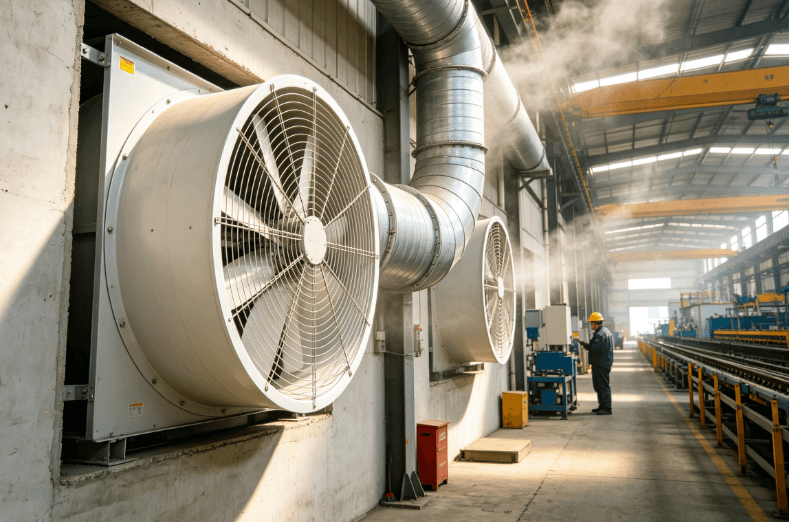
Why factories use industrial axial ventilation fans
Axial fans move air parallel to the fan axis, which makes them space-efficient for through-the-wall, inline duct, or plenum installations where high volumetric flow at relatively low to moderate static pressures is required. Typical factory uses include general area ventilation, local exhaust of heat or non-corrosive fumes, and providing bulk air movement for drying or cooling processes. When ventilation is being used as an engineering control for worker exposure, regulatory guidance requires the system be installed and operated to capture and remove contaminants safely; see OSHA ventilation requirements for construction and work areas for specifics on design and operation [1].
Common axial fan components and supplier facts
Supplier-page facts: COLORFAN lists industrial axial fan components and families including alloy hubs, several medium and large-size plastic and aluminum axial fan blades, and accessory parts such as bushings and shafts on its product pages. Example product entries on the supplier site include alloy hubs (10H, 8W, 8H, 6Z, 6W, 6H, 3W), and model-named blades such as Medium Size Plastic Axial Fan Blade S4Z and Medium Size Alloy Axial Fan Blade R4Z [supplier]. These listings establish that COLORFAN supplies both metal and plastic blade options and hub types for axial fans.
Technical considerations for factory ventilation
Engineering guidance: select fans based on the system static pressure requirement, desired volumetric flow (Q), and the operating point relative to fan efficiency. The U.S. Department of Energy (DOE) Fan System Cheat Sheet summarizes useful rules of thumb and fan-law relationships for speed, flow, head, and power — and highlights the value of operating near the fan’s best efficiency point and using variable-speed control where appropriate [2]. For industrial ventilation, consider the expected air density (temperature and altitude) and the effect of duct losses, filters, and enclosures on system static pressure.
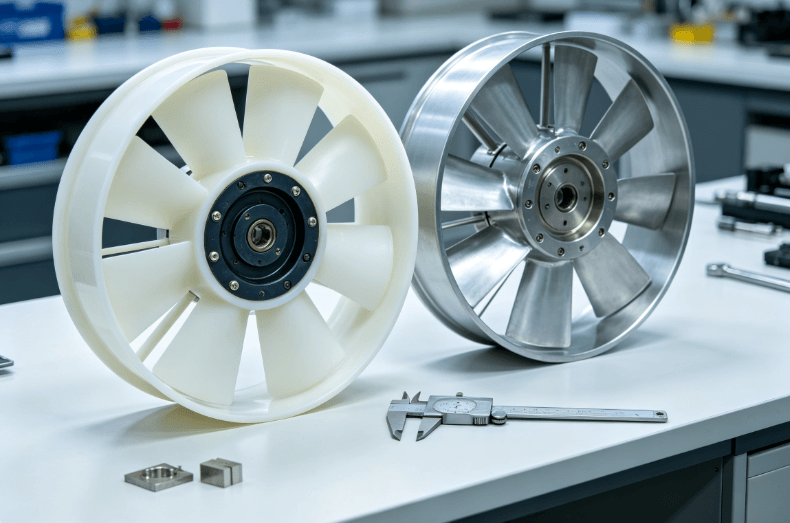
Material choices: plastic vs alloy blades and hubs
Materials affect durability, balance, corrosion resistance, and cost. Use material selection aligned with the process environment (temperature, chemical exposure, particulate abrasion). COLORFAN’s product pages show both plastic nylon blades (e.g., P5Z, K6Z, 7Z) and alloy/aluminum blades and hubs (e.g., R4Z, 9W alloy blades, and several alloy hubs). Those product names indicate available material families but do not by themselves provide performance data; confirm sizing and duty with an RFQ [supplier].
| Feature | Plastic blades (examples) | Alloy/Aluminum blades & hubs (examples) |
|---|---|---|
| Supplier examples | Medium Size Plastic Axial Fan Blade S4Z, P5Z, K6Z | Medium Size Alloy Axial Fan Blade R4Z, Large Size Aluminum Axial Fan Blade 9W; Alloy hub 8H |
| Typical advantages | Lower cost, corrosion-resistant in many chemical environments | Greater mechanical strength, higher temperature capability |
| Common applications | General ventilation, light-duty process air | Heavy-duty ventilation, higher-speed shafts, elevated temperatures |
| Supplier details available? | Product names listed on COLORFAN product pages; detailed duty specs require RFQ confirmation | Product names and hub families listed; duty, balance class, and certs require RFQ confirmation |
Installation and maintenance considerations
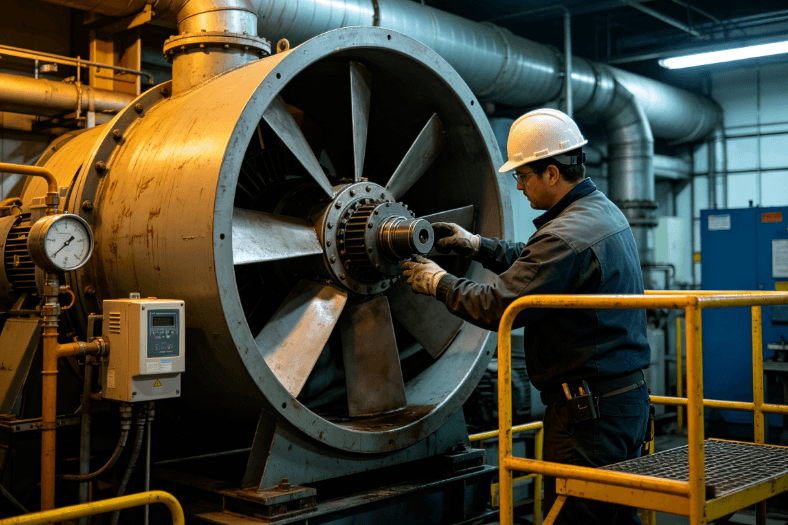
Engineering guidance: install axial fans to prevent backflow through workspaces, position intakes and discharges to avoid recirculation into occupied areas, and design ducting and hoods to capture contaminants at source. OSHA’s ventilation standards emphasize that local exhaust systems should be designed and operated to prevent harmful dispersion and to avoid drawing contaminants through workers’ breathing zones [1]. Regular maintenance steps typically include verifying blade balance, checking hub and shaft fit, inspecting for corrosion or wear, and confirming motor alignment and bearings.
Supplier-page facts, independent engineering guidance, and RFQ confirmation items
Supplier-page facts (from COLORFAN):
- COLORFAN lists axial fan components including alloy hubs and multiple plastic and alloy blade models such as R4Z, S4Z, P5Z, K6Z, 9W, and several alloy hub types on its product pages [supplier].
Independent engineering guidance:
- Select fans by required volumetric flow and system static pressure; consult fan curves and operate near the best-efficiency point where possible [2].
- When ventilation is used as an exposure control, design and operation must follow regulatory requirements (examples: OSHA ventilation criteria for design and discharge) [1].
RFQ confirmation items (need COLORFAN confirmation):
- Exact fan performance curves (CQM, Q-H, efficiency) at specified operating points.
- Material certifications, balance grade, allowable operating temperature, and chemical compatibility for blades and hubs.
- Available mounting/hub configurations, shaft sizes, and whether the product will be supplied as a complete fan assembly or as blade/hub components only.
- Compliance documentation, factory test reports, and recommended maintenance intervals.
Supplier/RFQ checklist
Before issuing a purchase order or specifying a replacement part, confirm the items below with COLORFAN:
- System design point: required Q (m3/h or CFM) and system static pressure (Pa or in.wg).
- Requested fan model or component name from COLORFAN product list (e.g., R4Z blade, alloy hub 8H) and whether an assembled fan is available.
- Material and finish requirements (temperature, corrosion resistance).
- Shaft size, mounting details, and balance class.
- Required documentation (material certificates, test curves, packing and shipping requirements).
Where to read more and next steps
For component details and currently listed models, see COLORFAN’s product pages: COLORFAN products and the supplier technical notes on blade design and materials: Axial fan blade design guide. For regulatory and engineering reference, consult OSHA’s ventilation rules and the DOE Fan System Cheat Sheet for fan-law basics and efficiency guidance [1][2].
Frequently asked questions
1. Are axial fans suitable for fume extraction in a factory?
Axial fans can be suitable for fume extraction when the contaminants are non-corrosive and the system static pressure is within the axial fan’s capability. For hazardous or toxic contaminants, follow applicable regulatory requirements and consult an industrial hygienist for control strategy and system design [1].
2. How do I choose between plastic and alloy blades?
Choose based on the operating environment: plastics offer chemical resistance and lower cost for many light-duty applications, while alloy or aluminum blades provide higher mechanical strength and improved temperature tolerance. Confirm specific material ratings and operating limits with the supplier.
3. Can I control fan airflow with a VFD?
Variable-frequency drives (VFDs) are a common method for controlling axial fan speed and airflow and can improve energy performance when the system permits. Evaluate motor compatibility and thermal limits before applying VFDs [2].
4. What documentation should I request in an RFQ?
Request fan performance curves, material certificates, balance/tolerance grades, assembly drawings, and any relevant factory test reports. See the RFQ checklist above for a minimal set of items to confirm with COLORFAN.
5. How often should I inspect industrial axial fans?
Inspection frequency depends on duty cycle and environment. Typical checks include visual condition of blades and hub, bearing noise/temperature, and shaft alignment. Ask COLORFAN for recommended maintenance intervals for the selected component or assembled fan.
Conclusion and non-coercive call to action
Axial fans are a practical option for many factory ventilation tasks. Use the technical guidance above to define system requirements, then confirm performance and material details with COLORFAN using the RFQ checklist. To review available components and model names listed by the supplier, visit COLORFAN products and the blade-design technical page for component descriptions. For project-specific sizing or regulatory compliance questions, prepare the RFQ items listed and contact COLORFAN for formal quotations and detailed specifications.
References
- [1] OSHA — 1926.57 Ventilation
- [2] U.S. DOE — Fan System Cheat Sheet (Advanced Manufacturing Office)
- [supplier] COLORFAN product listing and component pages