

Axial Fan Efficiency: Factors That Affect Industrial Fan Performance
Axial fan efficiency is a multi‑variable outcome driven by fan geometry, drive and control methods, system interaction, and operating environment. This article separates supplier facts, independent engineering guidance, and RFQ items so procurement and engineering teams can evaluate tradeoffs without assuming undocumented performance numbers.

Why efficiency matters for axial fans
Higher aerodynamic efficiency reduces electrical consumption for a given airflow and pressure requirement, which lowers operating cost and heat rejection in an industrial space. Efficiency also affects motor sizing, control strategy, and acoustic performance. However, efficiency is not a single number guaranteed across all operating points—real fans have a Best Efficiency Point (BEP) and lose efficiency when operated far from that point.
Supplier-page facts (what COLORFAN lists)
COLORFAN’s public product pages list component families relevant to axial-fan efficiency: alloy and aluminum hubs, multiple medium and large blade profiles in plastic and aluminum, and accessory parts such as bushings and shafts. Example product entries include alloy hubs for axial fan models (8H, 6W, 10H) and medium-size alloy or plastic blades such as R4Z and S4Z. These pages describe available materials and part families but do not state guaranteed overall fan efficiency for specific system conditions; such performance requires system selection and testing or CFD validation with confirmed operating point data [3].
Key aerodynamic and mechanical factors that affect axial fan efficiency
Below are the primary categories to review when comparing designs or drafting an RFQ. Where applicable, independent engineering guidance is cited.
Blade profile and material
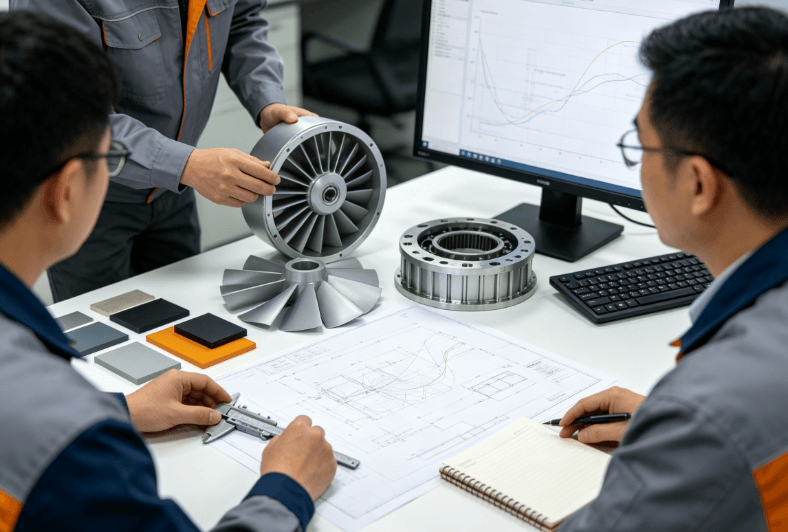
Blade aerofoil shape (sickle vs straight, chord distribution, twist) and surface finish influence lift/drag and tip losses. Materials (aluminum, alloy, or high‑strength plastics) affect manufacturing tolerances, stiffness, and susceptibility to deformation at speed—stiff blades retain their design shape at RPM and therefore maintain aerodynamic performance longer.
Hub design and root geometry
Hub diameter, hub‑to‑blade transition, and root fillets control inner‑span loading. A well‑designed hub reduces separation and rescues inner‑span efficiency that simple flat‑plate roots will lose.
Operating point and system interaction
Fan efficiency is determined at a specific flow rate and static pressure. System ducting, inlet conditions, and backpressure shift the operating point; if the fan runs away from its BEP, efficiency drops. The U.S. DOE Fan System Cheat Sheet documents how fan laws and BEP considerations factor in selecting speed control and matching motor sizing to system curves [1].
Speed control and drives
Variable-frequency drives (VFDs) are a common way to vary airflow while maintaining closer operation to BEP; the DOE guidance recommends VFDs for energy savings when systems operate across varying loads but emphasizes evaluating the whole system curve to avoid unintended inefficiencies [1].
Installation, clearances and inlet geometry
Poor inlet conditions (asymmetric approach flow, obstructions, inadequate straight duct length) create distortions that reduce effective efficiency and increase turbulence. OSHA ventilation rules stress that exhaust systems must be designed and operated to capture contaminants effectively—this implies fans should be selected and installed with system‑level air volumes and velocities in mind rather than as standalone components [2].
Practical maintenance and monitoring actions that preserve efficiency
Routine inspection for blade damage, imbalance, bearing wear, and buildup on blade surfaces preserves aerodynamic performance. Vibration analysis and periodic static/dynamic balancing are standard mechanical measures. Controls engineers should log operating point (flow vs. static pressure) so the system stays near BEP where feasible.
Comparison table — qualitative impacts on axial fan efficiency
| Factor | Typical direction of effect on efficiency | Notes (supplier vs. engineering) |
|---|---|---|
| Blade profile (sickle vs straight) | Higher (sickle) vs lower (simple flat) | COLORFAN lists multiple blade profiles; aero shape selection requires matching to system curve [3] |
| Material stiffness (Aluminum vs plastic) | Stiffer usually maintains efficiency at high RPM | Supplier pages show aluminum and plastic options; verify maximum RPM for plastic parts in RFQ |
| Hub and root design | Optimized hub improves inner‑span efficiency | COLORFAN lists alloy hubs; detailed hub geometry affects aero performance and may need drawings |
| Speed control (VFD) | Can improve overall energy use if matched to system | DOE fan guidance recommends evaluating VFDs vs dampers for energy savings [1] |
| Installation/inlet flow quality | Poor inlet reduces measured efficiency | OSHA and industry practice require system‑level design for effective capture and exhaust [2] |
Supplier/RFQ checklist (what to confirm before purchase)
- Required airflow (m3/h or CFM) and static pressure (Pa or in H2O) at expected operating point — confirmed by buyer (RFQ confirmation required).
- Preferred blade model or profile (e.g., R4Z, S4Z) and material (aluminum, alloy, nylon) — check supplier drawings for tolerances and max RPM [3].
- Hub model compatibility with shaft diameter and bore finish; confirm keying or balancing options (RFQ confirmation required).
- Maximum continuous RPM and recommended balancing grade for the selected blade/hub set (RFQ confirmation required).
- Required certifications or test reports (e.g., ISO balancing, material certificates) — request with RFQ if required by your specification.
- Environmental constraints (temperature, chemical exposure, particulate loading) that affect material selection and coating (RFQ confirmation required).
- Preferred control approach (VFD vs fixed speed/damper) and motor coupling details for motor sizing.
- Shipping packaging and spare-parts availability (blades, bushings, bolts) — ask supplier for spare part codes.
How to use supplier pages and independent sources together
Start with product families and drawings on supplier pages to identify candidate blade and hub combinations, then use independent engineering guides for system matching. For example, use COLORFAN product listings to short‑list blade geometries and then apply fan‑law and BEP guidance from the DOE to size drives and controls [1][3]. For ventilation systems that handle hazardous contaminants or require specific discharge handling, reference OSHA design and operation rules so the fan selection supports safe capture and disposal [2].
FAQs
Q1: Can I estimate axial fan efficiency from the blade material alone?
No. Material affects stiffness and surface finish, but efficiency depends on profile, hub interaction, RPM, and installation. Use supplier drawings plus system tests or CFD to estimate real efficiency.
Q2: Will a VFD always save energy on axial fans?
Not always. VFDs can save energy when airflow is reduced by speed instead of throttling, but savings depend on the system curve and how close operation remains to BEP. The DOE fan sheet provides guidance on when VFDs are beneficial [1].
Q3: How do installation effects compare with blade design for efficiency?
Installation effects (inlet distortion, obstructions) often degrade measured efficiency as much as suboptimal blade design. Address inlet geometry, straight duct lengths, and avoid asymmetric approaches during system design.
Q4: What documentation should I request in the RFQ?
Request CAD drawings, material certificates, maximum RPM and balancing class, and any test or QA reports the supplier can provide. See the RFQ checklist above for a starting list.
Conclusion and next steps
Axial fan efficiency is a system outcome: match blade geometry and hub design from supplier offerings to your system curve, use VFDs and controls when appropriate, and confirm mechanical limits and certifications in the RFQ. To review compatible blade and hub families on COLORFAN, see the axial fan blade design guide and the axial flow fan selection overview on COLORFAN’s site for product families and component references: Axial fan blade design and Axial flow fan selection guide [3]. If you want a supplier quote, include the RFQ checklist items above and request material drawings and max RPM data when you submit your RFQ.
References
- [1] U.S. Department of Energy — Fan System Cheat Sheet, Advanced Manufacturing Office:
- [2] OSHA — 1926.57 Ventilation
- [3] COLORFAN product and technical pages (example blade & hub listings)