

An adjustable pitch axial fan allows engineers to alter the blade angle at the hub to balance airflow and static pressure. Changing this angle directly alters the aerodynamic load on the entire cooling system. A steeper pitch moves more air per revolution but requires significantly more motor torque.
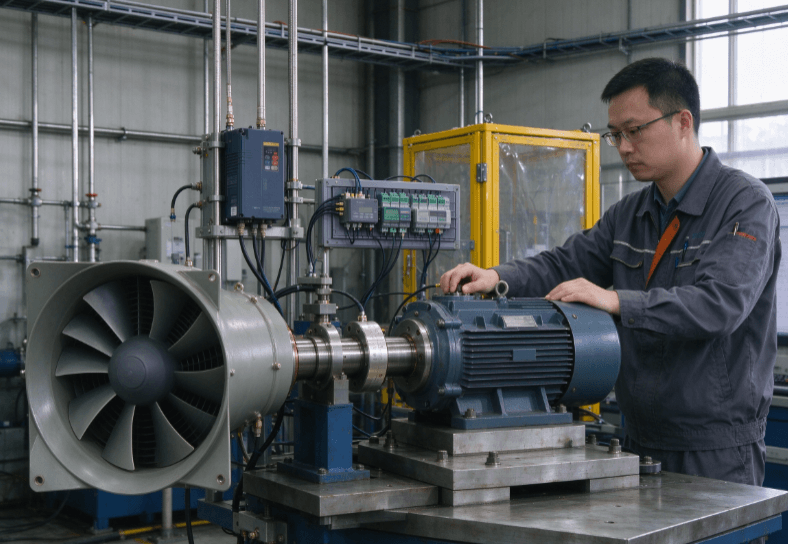
The Aerodynamics Behind Blade Pitch Adjustments
Engineers use modular fan hubs to set specific blade angles during final assembly. This mechanical flexibility ensures the impeller matches the precise system impedance of the target enclosure. A shallow pitch angle typically ranges from 15 to 25 degrees.
This flatter profile helps the fan push air effectively against dense heat sinks or heavy filters. It prevents aerodynamic stall when static pressure resistance is unusually high. In contrast, a steep pitch ranges from 30 to 45 degrees.
Steeper blades displace a larger volume of air with every motor rotation. They are primarily deployed in open-air systems with minimal physical obstruction. However, this increased volumetric flow demands robust motor specifications to prevent overheating.
Performance Tradeoffs: Airflow vs. Motor Load
Altering the geometry of an adjustable pitch axial fan fundamentally shifts its performance curve. You cannot simply increase the blade angle without evaluating the electrical consequences. Power consumption increases exponentially as the pitch becomes steeper.
If the motor lacks sufficient torque, a steep blade angle will cause RPM drops and eventual thermal failure. Engineers must cross-reference the fan curve against the operating environment. A precise balance maximizes cooling efficiency while protecting internal components.
Below is a technical comparison of how pitch adjustments impact core metrics:
| Pitch Angle Setup | Volumetric Airflow | Static Pressure Limit | Motor Torque Demand | Stall Risk |
| Shallow (15°-25°) | Lower | Higher | Lower | Minimal |
| Moderate (25°-35°) | Balanced | Balanced | Moderate | Moderate |
| Steep (35°-45°) | Maximum | Lower | Maximum | High |
The Step-by-Step Workflow for Setting Pitch Angles
Achieving the exact operating point requires a calculated assembly approach. Engineers follow a strict protocol when configuring modular hubs for mass production.
- Calculate System Resistance: Determine the total static pressure drop across all internal filters and heat sinks.
- Select Hub and Blade Materials: Choose between die-cast aluminum or glass-reinforced plastic based on environmental temperatures.
- Determine Optimal Angle: Cross-reference the required CFM against the manufacturer performance curves to find the correct index.
- Lock the Bushings: Secure the individual blades into the central hub using precision torque wrenches.
- Perform Dynamic Balancing: Test the fully assembled impeller to eliminate vibrations before final installation.
Key Industrial Applications for Variable Pitch Rotors
Heavy-duty manufacturing environments rarely share identical thermal loads. This variability makes fixed-pitch impellers less practical for multi-use equipment platforms. Diesel generator sets often rely on variable pitch systems to maintain stable engine temperatures.
For outdoor telecom cabinets, engineers frequently specify die-cast aluminum blades. Aluminum resists UV degradation and maintains structural integrity under extreme heat. These environments demand precise pitch tuning to account for seasonal air density changes.
Commercial HVAC systems often utilize glass-reinforced plastic fan blades instead. Polymer blades reduce the total rotating mass, which extends the operational life of the motor bearings. In hazardous ATEX zones, explosion-proof axial fans require specific pitch configurations to prevent sparking.
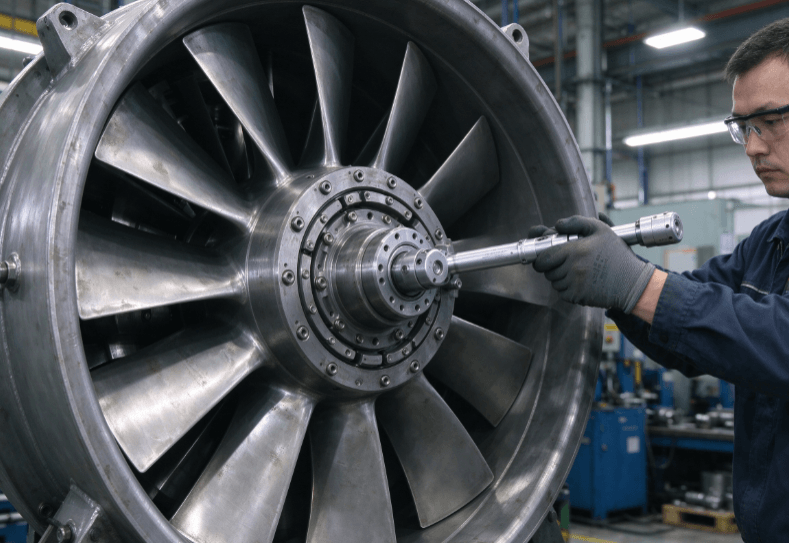
How Blade Pitch Influences Aerodynamic Efficiency
Every physical component within an enclosure creates resistance to airflow[1]. This resistance is measured as static pressure in Pascals or inches of water. An adjustable pitch axial fan must overcome this resistance to deliver its rated CFM[1].
If the pitch is too steep for the system impedance, airflow detaches from the blade surface. This detachment causes a stall condition, leading to severe vibration and acoustic noise. Sickle-shaped blades help mitigate this turbulence at the extreme blade tips[1].
Straight blade profiles prioritize raw airflow generation over acoustic dampening. Matching the exact blade profile with an optimized pitch angle ensures peak aerodynamic efficiency. Proper sizing prevents thermal throttling during peak operational cycles.
Material Selection for Variable Pitch Impellers
The physical operating environment strictly dictates the construction materials of the cooling assembly. Temperature extremes, chemical exposure, and mechanical weight limits all play a defining role. A fan built from the wrong materials will suffer premature structural failure.
Die-cast aluminum hubs and blades offer superior structural rigidity. They are ideal for heavy industrial machinery and outdoor equipment facing severe weather exposure[1]. Aluminum prevents blade deflection when operating at steep pitch angles under high aerodynamic loads.
Plastic fan blades utilize engineering polymers like glass-reinforced PBT. These configurations are lightweight and highly cost-effective for large-volume production. They serve as the established standard for general electronics and medium-duty HVAC units[1].
How Motor Technology Pairs with Pitch Adjustments
The motor drives the impeller and heavily influences the total lifespan of the unit. Engineers must pair their chosen blade pitch with appropriate motor winding specifications. A mismatch here leads to excessive power draw and rapid bearing degradation.
Alternating Current (AC) motors are historically used for their simplicity and rugged durability. Many legacy industrial machines rely on AC fans for harsh, unconditioned environments. AC motors offer limited speed control when dealing with fluctuating thermal loads.
Electronically Commutated (EC) motors represent the modern standard for high-efficiency cooling[1]. EC motors provide precise RPM control via external PWM control signals. Pairing an EC motor with an adjustable pitch hub maximizes long-term energy savings.
Evaluating OEM Capability for Custom Fan Assemblies
Transitioning a thermal design into mass production requires assessing factory capabilities. Procurement consultants must evaluate how suppliers handle modular components like axial fan blades, hubs, and bushings. Modular designs allow rapid prototyping without expensive custom tooling.
Partnering with an established manufacturer streamlines this engineering workflow. Companies like COLORFAN focus heavily on the R&D of high-end cooling solutions. Their product portfolio spans from 145mm to 2200mm, supporting highly customized OEM projects[1].
Engineers can select specific profiles, such as the P4Z plastic series or 7XL aluminum sickle fans[1]. Adjusting the pitch via specialized hubs allows COLORFAN to match precise static pressure requirements. This flexibility drastically reduces lead times compared to casting entirely new impellers.
When submitting an RFQ, provide detailed CAD models and expected system impedance curves. Buyers should request dynamic balancing data for their specific pitch configurations. This documentation guarantees long-term reliability under continuous commercial operation.
FAQ
What happens if the pitch angle on an axial fan is too steep?
A steep angle against high static pressure causes aerodynamic stall. The air detaches from the blade surface, resulting in severe mechanical vibration. This dramatically reduces cooling efficiency and accelerates motor wear.
How is the blade pitch adjusted on a modular hub?
Engineers loosen the specialized bushings securing the fan blades to the central hub. They manually rotate each blade to match specific angle index marks. The bushings are then tightened to specific factory torque standards.
Do adjustable pitch setups require larger EC motors?
They do not inherently require larger motors unless configured for extremely steep angles. Steeper pitches demand higher torque to move the increased air volume. Upgrading to EC motors provides precise RPM control to manage these aerodynamic loads efficiently.
Why use aluminum over plastic blades for adjustable hubs?
In large-volume production, plastic is highly cost-effective for medium-duty commercial cooling. However, heavy industrial environments typically require aluminum. Die-cast aluminum prevents blade deflection under high thermal stress and extreme aerodynamic loads.
What is the typical lead time for custom pitch configurations?
Standard modular parts assembled to specific pitch angles usually ship within a few weeks. Tooling for entirely new custom blade profiles extends lead times significantly. Sampling delays may occur when requesting highly non-standard motor windings.
Reference Sources
- AMCA Publication 211-22: Certified Ratings Program Product Rating Manual for Fan Air Performance (Air Movement and Control Association International).
- ISO 5801:2017: Industrial fans — Performance testing using standardized airways.
- IEC 60079-0: Explosive atmospheres – Part 0: Equipment – General requirements.
- UL 507: Standard for Electric Fans (Underwriters Laboratories).
- IPC-9592B: Requirements for Power Conversion Devices for the Computer and Telecommunications Industries.
Sourceshelp