

Selecting a qualified industrial ventilation fan manufacturer requires directly auditing their aerodynamic testing data, motor winding customization capabilities, and tooling flexibility for different blade profiles. You cannot rely on static datasheet maximums to make procurement decisions. A viable OEM partner must prove they can precisely match your factory enclosure’s specific system impedance curve while maintaining G6.3 dynamic balancing standards. This rigorous evaluation prevents severe thermal bottlenecks and motor bearing failures during large-volume continuous operation.
Engineers face strict constraints when managing factory air movement. Equipment density creates high resistance, drastically lowering actual volumetric flow compared to standard free-air ratings. To navigate these commercial and engineering hurdles, procurement teams must align technical requirements with a supplier’s genuine manufacturing capacity.
Overcoming System Impedance in Factory Enclosures
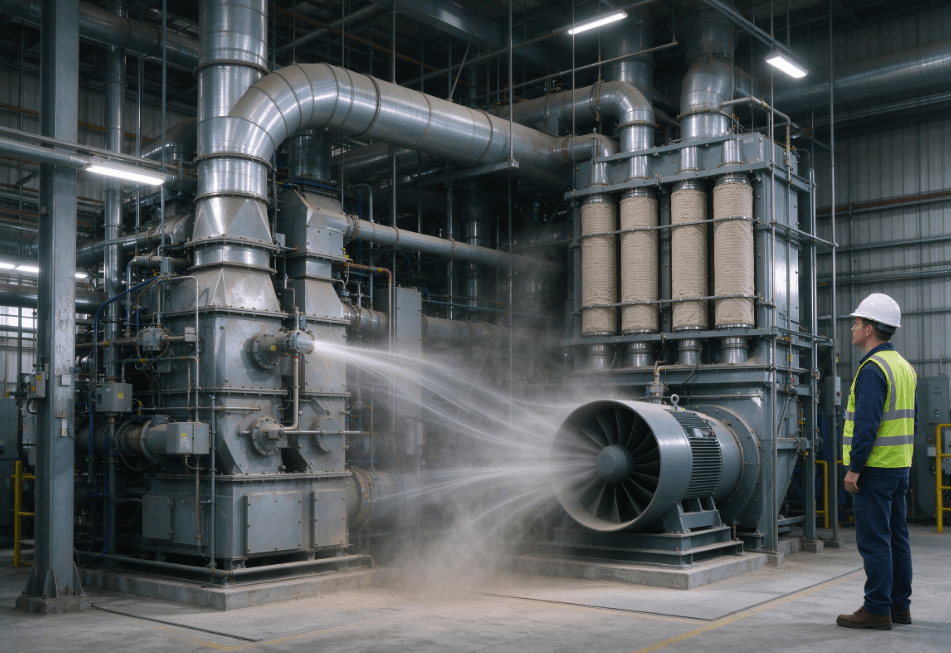
Factory air movement involves pushing air through complex, high-resistance pathways. Dust filters, dense internal machinery, and heavy ducting create significant static pressure. This aerodynamic drag drastically alters a cooling fan’s actual operating point.
An impeller only delivers its maximum CFM rating at absolute zero static pressure. As enclosure resistance rises, the delivered airflow drops proportionally. Engineers must plot the exact resistance curve against the supplier’s published aerodynamic performance data.
Calculating the precise intersection between these two metrics prevents dangerous thermal throttling. For a comprehensive engineering breakdown of these calculations, reviewing specific guidelines on axial fan selection sizing airflow static pressure is highly recommended. If the ambient factory temperature spikes, you must specify an oversized impeller to maintain the required temperature delta.
Tooling Flexibility for Blade Geometry and Hub Sizing
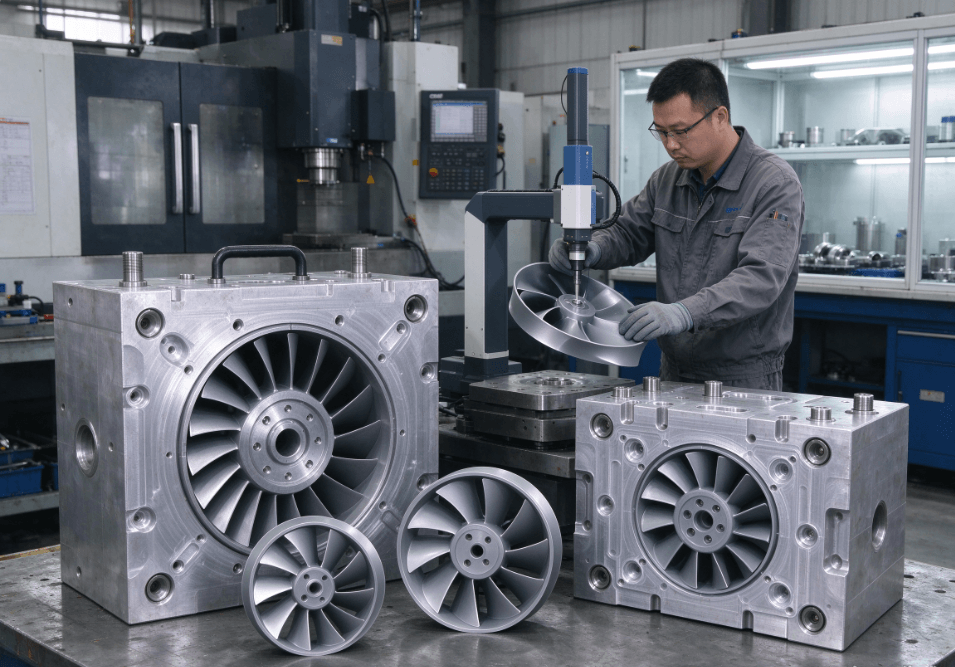
Standard off-the-shelf cooling solutions rarely fit highly specialized B2B industrial applications. Heavy machinery and wind power electronics often require custom housing dimensions and specific mounting hole configurations. A competent manufacturer owns their injection molds and die-casting tooling.
This vertical integration allows factories to rapidly prototype distinct blade pitches. Adjusting the attack angle of the impeller blades fundamentally changes the pressure-to-airflow ratio without upgrading the motor. Sourcing modular axial fans directly from a factory ensures you can swap blade configurations during the prototype phase.
Sickle blade geometries, such as those found in the 7XL series, feature heavily swept-back profiles. This specific design minimizes tip turbulence and heavily reduces operational acoustic resonance. Straight or paddle-style blades prioritize raw volumetric turnover when overcoming high internal resistance takes priority over noise reduction.
Material Selection Constraints for Harsh Environments
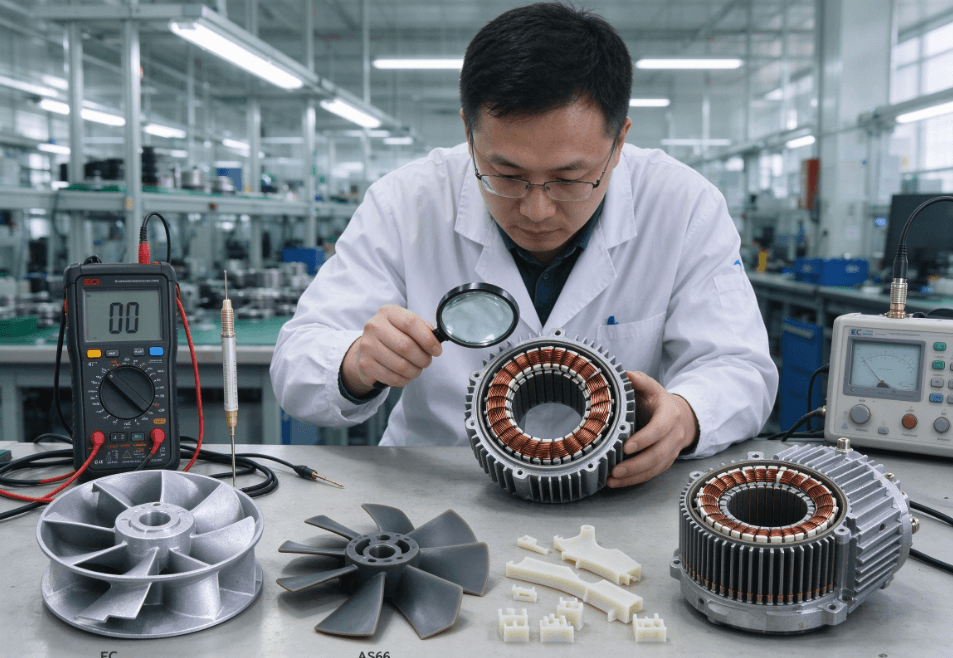
The physical operating environment strictly dictates blade and hub construction materials. Chemical exposure, mechanical vibration, and continuous extreme temperatures define these material limits. Selecting the wrong compound guarantees premature mechanical failure in the field.
| Material Type | Heat Tolerance | Vibration Resistance | Ideal Application |
| Die-Cast Aluminum | Up to 120°C | Excellent | Heavy machinery, outdoor exhaust |
| Glass-Reinforced PA66 | Up to 85°C | Moderate | Indoor OEM factory automation |
| Anti-Static Polymers | Up to 80°C | Moderate | Hazardous ATEX combustible zones |
In automotive or heavy engineering environments, constant vibration destroys brittle plastics. Aluminum hubs withstand aggressive mechanical shock and extreme temperature fluctuations over a decade-long lifecycle. For coastal factory installations, aggressive salt-spray testing data must dictate the final surface coating selection.
EC Motor Integration for Smart Thermal Management
Motor technology determines cooling system efficiency and total operational lifespan. Legacy factory machines rely heavily on standard AC induction motors. They connect directly to line voltage and offer exceptional durability, but lack dynamic speed control.
Modern industrial automation increasingly demands smarter, variable thermal management. Electronically Commutated (EC) motors represent the current standard for energy-efficient factory cooling. EC technology allows precise RPM control via 0-10V or PWM signals based on real-time thermal sensor data.
This dynamic scaling drastically reduces power consumption during idle factory shifts. It also extends internal bearing longevity by preventing the motor from constantly running at maximum RPM. Transitioning to EC motors often requires suppliers to custom-wind stators to match exact OEM voltage constraints.
Validation Metrics: Dynamic Balancing and ISO Standards
Industrial factory environments operate under strict commercial safety and performance regulations. A credible supplier rigorously tests their products against established international engineering standards. Relying on uncertified cooling equipment introduces massive corporate liability risks.
Aerodynamic performance must be systematically validated using standardized AMCA 210 or ISO 5801 testing airways. This ensures that the published airflow and static pressure curves are scientifically accurate. Electrical safety is equally paramount for safe, continuous commercial operation.
Every unit leaving the assembly line must undergo precise dynamic balancing. Imbalanced impellers cause eccentric weight distribution, which destroys motor bearings through micro-vibrations. High-end manufacturers balance their fans to ISO 1940 G6.3 or G2.5 specifications to guarantee long-term reliability.
Navigating the OEM RFQ Workflow and Lead Times
Transitioning a thermal design into mass manufacturing requires a highly realistic commercial strategy. Procurement managers must accurately assess supplier lead times and minimum order quantities (MOQ). Standard configurations usually ship within a few weeks from established B2B suppliers.
Sampling delays frequently occur when requesting non-standard blade pitches or customized IP68 waterproofing treatments. An effective Request for Quotation (RFQ) prevents costly miscommunications early in the sourcing cycle. You must include 3D CAD models, exact voltage constraints, and mandatory compliance certifications in your initial inquiry.
When evaluating an industrial ventilation fan manufacturer, verify their production scalability. A supplier handling 500-unit pilot runs must also possess the automated winding and assembly lines to support 50,000-unit annual contracts. Partnering with a capable factory like COLORFAN streamlines this transition from prototype testing to full-scale factory integration.
FAQ
What is the standard MOQ for customized OEM ventilation fans?
Minimum order quantities for custom industrial cooling fans typically start between 200 and 500 units. This threshold depends entirely on whether custom aluminum die-casting tooling or new plastic injection molds are required.
How do sampling delays affect the B2B procurement workflow?
Sampling delays typically occur when engineers request specialized EC motor windings or non-standard blade pitches. While off-the-shelf samples ship in days, custom aerodynamic testing and custom stator winding add three to four weeks to the timeline.
Why is dynamic balancing critical for factory air movement?
Dynamic balancing ensures the fan impeller rotates without eccentric weight distribution. This prevents severe micro-vibrations that cause premature motor bearing failure and structural damage to surrounding factory equipment.
Can a manufacturer match an existing enclosure impedance curve?
Yes, a capable B2B supplier can adjust the blade pitch angle or modify the motor stator to hit a specific operating point. This ensures the fan delivers the exact CFM required against your specific static pressure resistance.
What testing data should procurement request during the RFQ stage?
Buyers must request L10 bearing life expectancy data, ISO 5801 aerodynamic performance curves, and IP rating validation reports. Requesting UL 507 or ATEX certifications is strictly necessary for specialized or hazardous factory environments.
Reference Sources
- ISO 5801:2017: Industrial fans — Performance testing using standardized airways.
- AMCA Publication 210-16: Laboratory Methods of Testing Fans for Certified Aerodynamic Performance Rating.
- ISO 1940-1:2003: Mechanical vibration — Balance quality requirements for rotors in a constant (rigid) state.
- UL 507: Standard for Electric Fans (Underwriters Laboratories).
- IEC 60079-0: Explosive atmospheres – Part 0: Equipment – General electrical safety requirements.