

Selecting a qualified axial fan bushing supplier requires sourcing the exact mechanical interface that safely locks an impeller hub concentrically to a motor shaft. The operational lifespan of an industrial fan depends entirely on securing the correct fitment (taper-lock vs. parallel bore), specifying the right material (such as S45C steel or die-cast aluminum), and adhering to strict replacement tolerances. A sub-millimeter deviation in this single component instantly transfers aggressive centrifugal vibration directly into the motor bearings. For OEM engineers and procurement teams, sourcing a precision-machined axial fan bushing is the primary defense against dynamic imbalance and catastrophic structural fatigue.
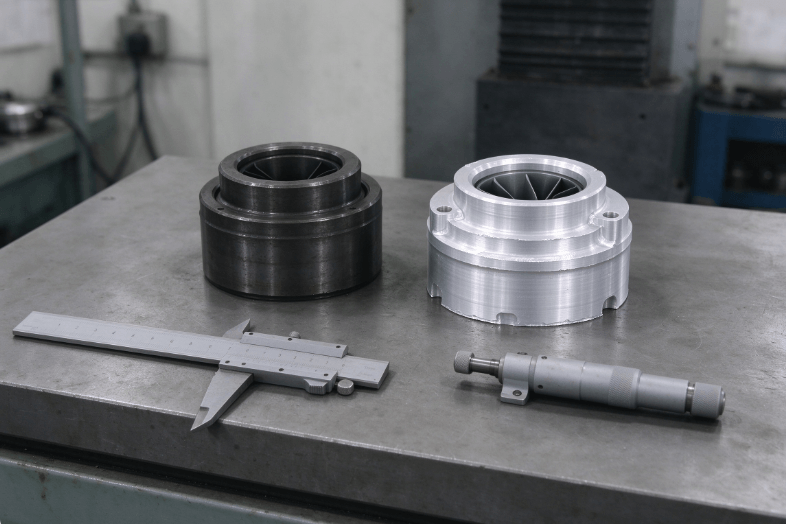
The Mechanical Reality of Torque Transfer
In industrial ventilation, the bushing cannot rely on a simple friction fit. It acts as the structural bridge that absorbs extreme rotational torque during motor startup while withstanding continuous centrifugal loads.
The core requirements of this component include:
- Zero-Play Torque Transmission: Transferring kinetic energy from the drive shaft to the impeller without microscopic slipping.
- Concentric Alignment: Maintaining absolute true-center rotation to prevent low-frequency harmonic resonance.
- Modular Maintenance: Allowing technicians to decouple the heavy blade assembly from the drive unit without scoring or damaging the underlying motor shaft.
When a bushing loses its dimensional integrity, the resulting rotational play creates immediate structural fatigue.
Fitment Standards: Taper-Lock vs. Parallel Bores
Engineers must specify the correct bore design based on operating RPM, environmental vibration, and maintenance schedules. Two primary mechanical configurations dominate industrial fan manufacturing.
- Taper-Lock Bushings (QD/Split-Sleeve): Engineered for high-vibration and heavy-duty environments. As the mounting bolts are torqued down, the split sleeve contracts evenly around the shaft. This creates a high-friction shrink-fit that completely eliminates keyway backlash.
- Parallel Bores (Straight Bores): A straightforward cylindrical sleeve secured by a keyway and set screws. While highly cost-effective for low-RPM commercial HVAC units, they are prone to fretting corrosion if the bore tolerance is even slightly loose.
Component Comparison Table
| Specification | Taper-Lock Design | Parallel Bore Design |
| Locking Mechanism | Split-sleeve compression | Set screw and keyway |
| Vibration Resistance | Exceptional | Moderate |
| Disassembly | Simple extraction without shaft damage | High risk of seizing over time |
| Ideal Application | Heavy-duty industrial impellers | Low-torque commercial ventilation |
Material Selection for High-Stress Environments
A mismatch in bushing materials often leads to galvanic corrosion or mechanical shearing under load. The operating environment dictates the required metallurgy.
- Die-Cast Aluminum Alloys: Standard for modular hub architectures. Aluminum provides excellent corrosion resistance and significantly lowers the rotational moment of inertia, reducing wear on the motor during startup sequences.
- S45C Steel and Cast Iron: Mandatory for massive industrial cooling tower fans exceeding 1,000mm in diameter. These heavy-duty metals deliver the absolute shear strength required to handle massive torque spikes from industrial diesel engines.
- Protective Surface Treatments: In chemical processing plants or coastal facilities, raw steel components will rapidly oxidize and weld themselves to the motor shaft. High-quality suppliers apply zinc plating or phosphating to guarantee safe removal during future maintenance.
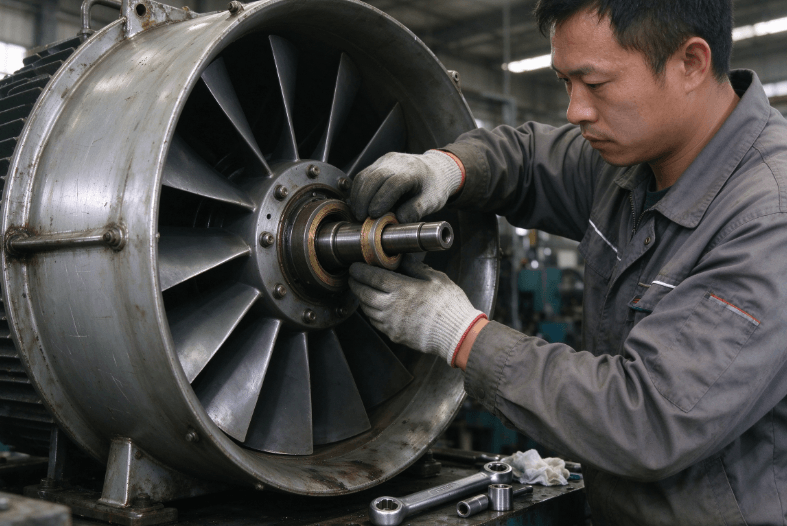
Evaluating OEM Manufacturing Capabilities
Sourcing industrial components based exclusively on unit pricing often results in rapid system failure. A competent axial fan bushing supplier must demonstrate specific manufacturing controls.
- Micrometer Machining Precision: A bore clearance mismatch of just 0.05mm will trigger violent harmonic vibration at operational speeds. The factory must utilize advanced CNC turning centers to guarantee tight dimensional tolerances.
- Integrated Balancing: The bushing must integrate seamlessly with the central hub and be capable of achieving ISO 1940 balancing standards (G6.3 or G2.5) to ensure total rotational stability.
- Modular System Engineering: Industry-leading manufacturers design their components as a cohesive ecosystem. As detailed in this axial fan parts guide outlining blade, hub, and bushing engineering, modular architecture allows operators to replace an isolated Z42-11-110 alloy bushing without forcing the costly replacement of the entire aluminum hub.
Strict Replacement and Fitment Protocols
Replacing a worn bushing demands strict procedural adherence. An improper installation introduces artificial imbalance, destroying the equipment from the inside out.
- Drive Shaft Inspection: Clean the motor shaft completely. Utilize a micrometer to check for surface scoring, metal burrs, or dimensional wear that could compromise the new fit.
- Keyway Seating: Slide the replacement bushing onto the shaft by hand. The metal key must seat into the keyway without forced binding. Hammering the key alters the rotational center.
- Incremental Torque Sequence: For taper-lock systems, tighten the bolts in an alternating, circular pattern. Uneven torque application will distort the hub alignment and ruin concentricity.
- Mandatory Rebalancing: Any physical change to the mass of the hub or bushing shifts the center of gravity. The fully assembled impeller must undergo dynamic rebalancing before returning to active service.
FAQ
What is the standard MOQ for custom CNC machined bushings?
For custom-machined dimensions, minimum order quantities generally range from 100 to 500 units depending on the tooling requirements. However, suppliers focused on modular systems often maintain stock of standard taper series for low-volume replacement orders.
How do I accurately determine the correct bushing size for my fan hub?
You must measure the exact motor shaft diameter with a caliper, confirm the keyway width, and match the specific taper series (e.g., 2012, 2517) that is structurally compatible with your existing hub socket.
Can a slightly loose bushing cause immediate motor bearing failure?
Yes. A loose mechanical fit allows for microscopic radial play. This play generates severe centrifugal vibrations that transfer directly down the drive shaft, destroying motor bearings and frequently causing the fan blades to fracture.
Why are zinc-plated components recommended for outdoor cooling towers?
Zinc plating creates a barrier that prevents galvanic corrosion between a steel drive shaft and an aluminum fan hub. This treatment stops the assembly from fusing together via oxidation, ensuring smooth disassembly when maintenance is required.
Need a Bushing That Matches Your Fan Hub and Motor Shaft?
A bushing that is “close enough” in size can introduce vibration, shaft wear, and premature bearing failure. COLORFAN supplies precision-machined axial fan bushings for industrial fan assemblies, with options for different shaft diameters, keyways, hub interfaces, and operating conditions.
Whether you are sourcing bushings for OEM fan production, replacement parts, or a custom axial fan assembly, send us your shaft diameter, hub dimensions, bushing type, material requirements, and expected quantity. Our team can help evaluate the required fitment and provide a suitable manufacturing solution.
Contact COLORFAN to discuss your axial fan bushing specifications and request a quotation.
Reference Sources
- AMCA Publication 211: Certified Ratings Program – Product Rating Manual for Fan Air Performance.
- ISO 1940-1: Mechanical vibration — Balance quality requirements for rotors in a constant (rigid) state.
- COLORFAN Engineering Guide: Axial Fan Parts Guide: Engineering the Blade, Hub, and Bushing.
- VDI 2044: Performance testing of fans (Association of German Engineers).