

A plastic axial fan is a high-volume, low-pressure air movement device equipped with thermoplastic impellers. These fans are engineered specifically to reduce rotational mass while providing intrinsic resistance to chemical degradation. In industrial thermal management, replacing metal components with specialized polymers eliminates structural oxidation risks. Engineers specify these units for environments where acidic fumes or high humidity cause standard metal blades to fail prematurely.
System designers constantly evaluate weight, cost, and durability when selecting cooling components. A standard metal fan may suffice for general warehouse ventilation but often corrodes in harsh process conditions. This guide examines the mechanical boundaries, material tradeoffs, and exact deployment scenarios for polymer-based cooling systems.
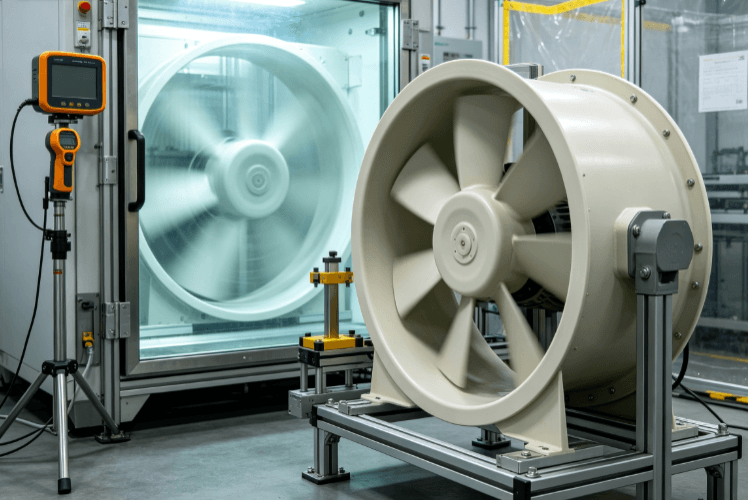
Why Choose a Plastic Axial Fan for Corrosive Environments?
Thermoplastic impellers excel in chemically aggressive environments due to their dense molecular structure. Unlike steel or untreated aluminum, polymers do not undergo galvanic corrosion when exposed to electrolytes or moisture.
In large-volume production, manufacturers typically utilize Polybutylene Terephthalate (PBT) or Polyamide (PA66) for the blade assembly. These materials naturally repel water and resist mild acids, alkalis, and salt sprays.
To meet stringent industrial compliance, high-grade plastic components are often compounded with flame retardants. This formulation ensures the fans achieve a UL 94V-0 flammability rating, preventing fire propagation inside electronic enclosures.
Marine applications and chemical processing plants rely heavily on these inert properties. The absence of surface oxidation ensures that the blade profile remains aerodynamically stable over its entire lifecycle.
Key Corrosion Resistance Advantages:
- Inherently inert to saltwater and continuous high ambient humidity.
- Resists degradation from mild industrial solvents and machine lubricants.
- Eliminates the need for secondary anti-corrosion surface coatings.
- Maintains dynamic balance without flaking or surface scaling.
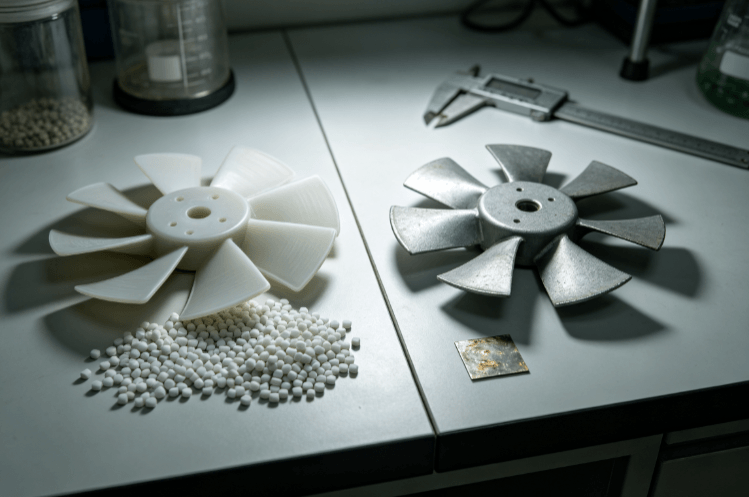
Thermoplastic vs. Cast Aluminum Impellers: A Performance Comparison
Material selection directly dictates a fan’s operational envelope and system compatibility. While cast metal dominates heavy industrial exhaust, engineered plastics rule precision cooling.
A plastic axial fan requires significantly less starting torque than its metal counterpart. This lower inertia greatly extends the lifespan of the motor bearings. It is particularly beneficial in systems utilizing rapid start-stop cycles or variable speed PWM control.
Metal impellers generate higher acoustic noise due to their rigidity and rotational mass. Conversely, polymer blades naturally dampen high-frequency motor vibrations. This acoustic advantage makes plastic the preferred material for medical devices, office servers, and quiet HVAC applications.
However, aluminum maintains superior structural rigidity under extreme aerodynamic loads. System engineers must carefully weigh static pressure requirements against material strain.
| Feature | Plastic (PBT / PA66) | Cast Aluminum |
| Corrosion Resistance | Excellent (Inherent) | Moderate (Requires coating) |
| Weight & Rotational Inertia | Very Low | High |
| Starting Torque Required | Minimal | Moderate to High |
| Maximum Temperature | ~70°C to 85°C | >120°C |
| Vibration Damping | High | Low |
Operational Limits: Temperature Ranges and Structural Constraints
Despite their chemical resilience, polymer fans operate within strict mechanical boundaries. Thermal constraints primarily dictate their application scope.
Thermoplastic materials are susceptible to mechanical creep at elevated temperatures. Typical continuous operating limits for standard plastic impellers range strictly from -20°C to 70°C. In environments exceeding 85°C, the plastic can soften, leading to permanent blade deformation under high RPMs.
While resistant to many substances, polyamides can absorb ambient moisture in highly saturated environments. This absorption slightly alters the dimensional stability and weight of the blade over time. Engineers must account for these micro-variations when designing tight-clearance fan housings.
Tooling limitations also restrict maximum fan diameters. Injection molding large-scale plastic blades introduces shrinkage variables during the rapid cooling phase. This uneven material shrinkage can compromise the dynamic balance of the impeller.
For diameters exceeding 800mm, manufacturers often transition back to metal housings and blades. If plastic is mandatory for a large diameter, expensive fiberglass-reinforced composites (FRP) must be utilized to stabilize the mold and prevent warping.
High-Volume Industrial Applications for Plastic Fans
The unique properties of molded plastics make them indispensable across highly specific manufacturing sectors. They are the default choice for environments demanding efficiency, low noise, and chemical resistance.
- Data Center Cooling: Server racks utilize compact polymer fans driven by smart EC motors. The low weight allows for extreme RPMs to dissipate heat from high-density CPUs without inducing chassis vibration.
- Battery Thermal Management: EV charging stations and energy storage systems require non-conductive cooling. Plastic impellers prevent electrical arcing while effectively managing ambient heat loads.
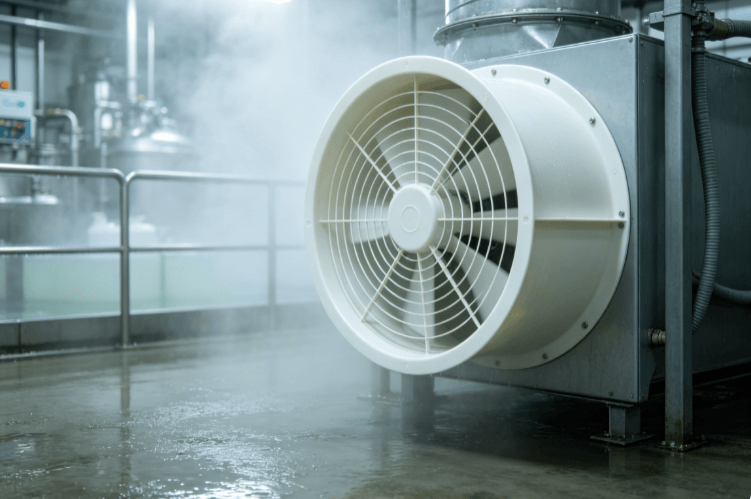
- HVAC Condenser Units: Coastal HVAC installations suffer rapid metal degradation. Polymer blades withstand continuous salt fog exposure without losing aerodynamic efficiency.
- Telecom Enclosures: Outdoor 5G base stations rely on UV-stabilized plastic fans to maintain airflow. These units must survive extreme weather variations while operating continuously.
- Agricultural Ventilation: Greenhouses require continuous air circulation in high-humidity conditions. Polymer fans resist the harsh fertilizers and organic acids consistently present in these environments.
Custom Plastic Axial Fan Procurement and OEM Tooling
Transitioning from standard catalog parts to custom airflow solutions requires careful supplier evaluation. Commercial realities often dictate production workflows and material choices.
For OEM applications, custom blade pitches or specific hub dimensions require dedicated injection molds. Tooling development typically takes 4 to 6 weeks to complete. Sampling delays may occur when fine-tuning the mold to achieve precise balancing tolerances.
When specifying components, engineers should thoroughly review the technical capabilities of the manufacturer. For example, facilities focusing on high-end thermal management, such as those producing the plastic axial fan series from COLORFAN, offer diverse polymer blends tailored to specific static pressure requirements.
Evaluating a supplier requires looking far beyond the basic unit price. Project managers must confirm the factory’s ability to integrate modern motor technology. As detailed in their technical guide for industrial applications, modern cooling systems require precise speed control combined with lightweight impellers to maximize energy efficiency.
Minimum Order Quantities (MOQs) for custom thermoplastic fans are generally higher than off-the-shelf metal units. This is entirely due to the extensive setup time required for industrial injection molding machines. Standard RFQ workflows should include clear specifications regarding IP ratings, maximum operating temperatures, and expected continuous run times.
Testing protocols form a critical part of the procurement workflow. Reputable factories conduct wind tunnel testing to verify CFM and static pressure capabilities. They also perform baseline vibration analysis to ensure the injection-molded hubs meet strict ISO balancing standards.
FAQ
What is the continuous operating temperature limit for standard plastic impellers?
Most standard PBT or PA66 impellers are rated for continuous operation between -20°C and 70°C. Exceeding these thermal limits causes material softening and dangerous blade deformation at high speeds.
Why is a plastic axial fan preferred for coastal HVAC applications?
Coastal environments expose equipment to highly corrosive salt fog daily. Thermoplastics are naturally immune to galvanic corrosion, eliminating the need for protective metal coatings that eventually chip and fail.
How does injection molding affect high-volume manufacturing tolerances?
During the injection molding process, liquid plastics shrink slightly as they cool. Manufacturers must calculate this exact shrinkage rate during tooling design to ensure the blades remain perfectly balanced for high-RPM operation.
What are the typical lead times for custom OEM fan tooling?
Creating a new steel injection mold for a custom blade profile usually takes 4 to 6 weeks. Subsequent physical testing and balancing adjustments often add 1 to 2 weeks before mass production can safely begin.
Can plastic impellers be used outdoors without degrading?
Yes, but the base polymer must be heavily formulated with UV stabilizers. Without proper UV inhibitors, prolonged sunlight exposure causes the plastic to become brittle and eventually fracture under mechanical stress.
Reference Sources
- ISO 13348: Industrial fans — Tolerances, methods of conversion, and technical data presentation.
- UL 94: Standard for Tests for Flammability of Plastic Materials for Parts in Devices and Appliances.
- ASTM D638: Standard Test Method for Tensile Properties of Plastics.
- AMCA Publication 211: Certified Ratings Program Product Rating Manual for Fan Air Performance.