

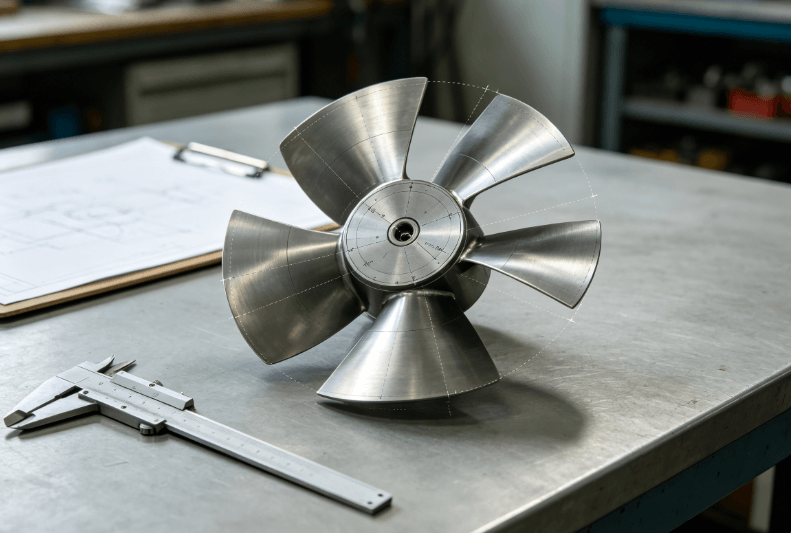
Axial fan blade design directly influences how a fan moves air: the blade shape, chord distribution, camber (twist), and tip geometry change airflow pattern, pressure rise and efficiency. This article summarizes common blade-shape effects, key geometric variables to evaluate, practical trade-offs for material and manufacture, and what to request from a supplier when you need a replacement or custom blade.

Why blade shape matters for axial fans
Blade shape sets the local incidence angle and influences the distribution of lift and drag along the blade span. A blade that produces higher lift near the root or mid-span will increase volume flow and static pressure for a given tip speed, while higher drag or separation-prone shapes reduce efficiency. Designers balance aerodynamic objectives (flow rate, static pressure) against mechanical constraints (strength, vibration, manufacturability).
Common blade profiles and their typical airflow effects
In practical industrial axial fans the following blade families appear frequently:
- Sickle or swept blades — often used to improve off-design stability and reduce noise.
- Straight or constant-chord blades — simpler to manufacture and predictable in behaviour near design point.
- High-camber blades — increase pressure rise for a given speed but can be more sensitive to stall.
- Tip treatments (e.g., tip clearance shaping) — used to reduce leakage and tip vortices that lower efficiency.
Each shape shifts the fan characteristic curve (flow vs. head) and affects where the fan operates relative to its best efficiency point (BEP). Operating significantly away from BEP raises power draw and acoustic emissions; control strategies such as variable-frequency drives are commonly used to manage that operating point [2].
Key geometric parameters that control flow
When assessing or specifying blade design, pay attention to:
- Blade chord and span distribution — determine the area available for lift and the loading distribution.
- Twist (pitch) distribution — manages local incidence over the radius and helps align blade sections to the local flow angle.
- Camber (airfoil section) — controls lift/drag at each section; thicker sections may improve structural stiffness but raise profile losses.
- Leading- and trailing-edge shaping — affects onset of separation and noise generation.
- Tip geometry and clearance — tip losses scale with gap and vortex strength.
Materials, manufacturing and trade-offs
Material choice (aluminum alloys, cast alloys, engineered plastics, nylon) affects weight, stiffness, fatigue life and aerodynamic tolerances. Cast or machined aluminum blades tend to hold tighter aerodynamic tolerances and allow thinner sections; plastic/nylon blades offer corrosion resistance and lower cost for some applications. The COLORFAN blade design overview and product listings show plastic and alloy blade families available from the supplier but do not replace engineering validation for a given duty.

Performance testing and modelling guidance
Predicting fan performance uses a combination of empirical data, CFD, and the fan laws. For system-level selection and energy considerations, established guidance such as the U.S. Department of Energy’s fan-system summaries explains the importance of operating near the BEP and provides fan-law relationships (Q, N, H, P) and control options such as variable-frequency drives [2]. For workplace ventilation and exhaust, applicable regulatory design goals for capture and safe discharge should be consulted, for example to avoid drawing contaminants through occupied zones [1].
Comparison table: typical blade-shape trade-offs
| Blade type | Typical aerodynamic benefit | Manufacturing notes | Common uses |
|---|---|---|---|
| Sickle / swept | Improved stability, noise reduction at off-design | More complex tooling | HVAC, industrial process fans |
| Straight / constant-chord | Predictable BEP, simpler flows | Lower cost | General-purpose axial fans |
| High-camber | Higher pressure per stage | Requires precise balance and validation | Applications needing higher static pressure |
| Plastic / nylon | Corrosion resistance, damping | Dimensional sensitivity to temperature | Cooling, mild industrial |
| Aluminum / alloy | Tighter tolerances, higher stiffness | Higher material cost | High-speed, precision fans |
Supplier-page facts (what COLORFAN lists)
- COLORFAN lists axial fan blades and blade families including medium-size alloy blades (e.g., R4Z) and multiple plastic/nylon blade part types on its product pages.
- The supplier site contains an Axial Fan Parts Guide and product entries for alloy hubs and various blade models.
- Product pages document available materials and model names but do not publish universal performance curves, certification lists or guaranteed compatibility with every motor or hub assembly; those items require confirmation.
Independent engineering guidance (sources and practical notes)
- Fan laws and control: Use fan-law scaling and operate as near the BEP as practical to reduce power and noise; variable-speed drives are a common control method [2].
- Workplace ventilation: When axial fans are used for local exhaust of hazardous substances, regulatory guidance requires the ventilation system to be designed, constructed and operated to capture and safely discharge contaminants and to avoid drawing contaminants through workers’ breathing zones [1].
- Testing: Performance should be validated by test or CFD for new blade shapes and for retrofits where system resistance or operating speed differs from the supplier’s catalog test conditions.
RFQ checklist for axial fan blade replacements or custom blades
Provide these items when requesting a quotation; items marked “(RFQ confirmation required)” should be confirmed with COLORFAN if not present on a chosen product page.
- Required blade model or drawing (CAD) or photograph of existing blade assembly.
- Blade outer diameter (mm) and hub inner diameter / shaft bore details (RFQ confirmation required).
- Number of blades and rotational direction (clockwise/counterclockwise as viewed from intake).
- Operating speed (RPM) and expected continuous duty cycle (RFQ confirmation required).
- Target airflow (m3/h or CFM) and static pressure or system-resistance curve (RFQ confirmation required).
- Preferred material (alloy, aluminum, plastic/nylon) — COLORFAN lists alloy and plastic blade families but confirm specific alloy grades or nylon formulations (RFQ confirmation required).
- Environmental conditions: temperature range, corrosive atmosphere, particulate loading.
- Balancing grade, surface finish or coating requirements (RFQ confirmation required).
- Any certification or documentation needs (RoHS, material test reports) (RFQ confirmation required).
- Delivery and packaging preferences; expected quantities for unit pricing.
FAQ
How does blade pitch affect airflow?
Increasing pitch (angle of attack) generally raises developed pressure and flow up to the stall limit; beyond that, separation reduces both flow and efficiency. Specify the intended operating point so the supplier can recommend an appropriate pitch distribution.
Can I replace a metal blade with a plastic blade?
Possibly, but check mechanical constraints (centrifugal stresses at rpm), dimensional stability under temperature and any chemical exposure. Provide operating rpm and environmental conditions to the supplier for validation.
Do blade-tip shapes reduce noise?
Tip shaping and reduced tip clearance can lower vortex strength and broadband noise, but the effectiveness depends on the whole-system design and mounting conditions.
When should I request a performance curve?
Request a tested performance curve whenever you are replacing a blade in a system with significant resistance, changing motor speed, or designing for near-critical ventilation tasks; curves let you verify the operating point against system resistance.
What documentation should I include with an RFQ?
Include mechanical drawings, operating RPM, desired flow/pressure, environment, quantity and any inspection or certification needs. The checklist above lists typical items.
Conclusion and non-coercive next steps
Blade shape is one of the primary levers for tuning axial-fan airflow, pressure and noise. Use the geometric parameters and trade-offs above to frame requirements, validate designs with testing or CFD, and include the RFQ checklist items when contacting a supplier. For COLORFAN product information and part families, see their blade design overview and parts guide pages linked above. If you’d like, prepare a short RFQ using the checklist and the supplier can confirm compatibility and provide quotations.
References
- [1] OSHA – 1926.57 Ventilation: https://www.osha.gov/laws-regs/regulations/standardnumber/1926/1926.57
- [2] U.S. Department of Energy – Fan System Cheat Sheet: https://betterbuildingssolutioncenter.energy.gov/sites/default/files/attachments/Better%20Plants%20-%20Fan%20System%20Cheat%20Sheet.pdf