

Wind turbines generate massive amounts of thermal energy during operation. This heat comes from generators, gearboxes, and transformers housed inside the nacelle. Without efficient thermal management, internal temperatures can exceed safe operational thresholds.
An engineered cooling solution is critical for structural safety. High-capacity airflow prevents component degradation and ensures consistent power generation. Forced convection remains the most reliable method for controlling these extreme thermal loads.
This guide explains the working principles and critical design constraints. You will learn how to evaluate an axial fan for wind turbine systems. We cover material selection, aerodynamic profiles, and harsh environmental resistance standards required for modern renewable energy projects.
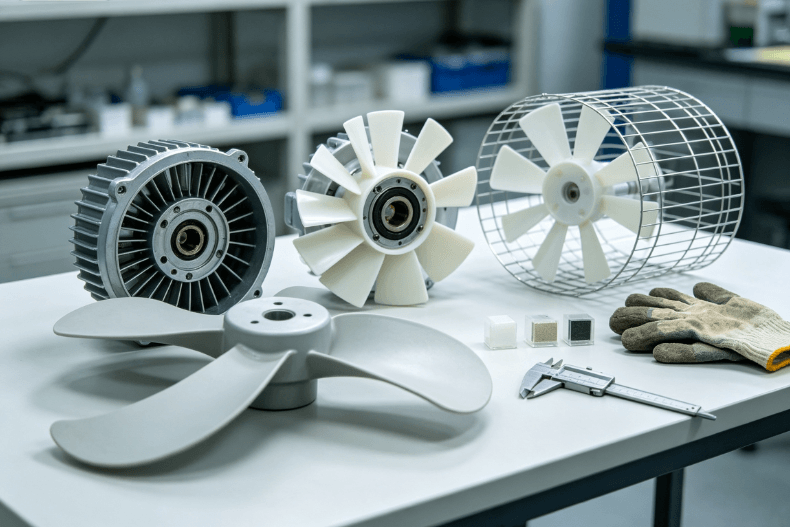
Why Thermal Management Matters in Wind Energy
Wind turbine nacelles operate in highly confined elevated spaces. The mechanical and electrical conversion processes produce extreme thermal loads. Continuous heat buildup degrades lubrication and damages sensitive electrical insulation.
Engineers must address several primary heat sources inside the turbine.
- Generators: Copper and iron losses generate continuous heat during power production.
- Gearboxes: Intense mechanical friction creates extreme thermal output.
- Power Electronics: Inverters require strict temperature control to prevent thermal shutdown.
To dissipate this heat, systems rely heavily on forced convection cooling. Active airflow carries thermal energy away from critical moving parts. The hot air is then expelled safely outside the nacelle structure.
Proper airflow management prevents thermal stratification inside the nacelle. Stratification occurs when hot air becomes trapped near the ceiling. Industrial fans disrupt these layers, maintaining a uniform ambient temperature.
The Role of an Axial Fan for Wind Turbine Cooling
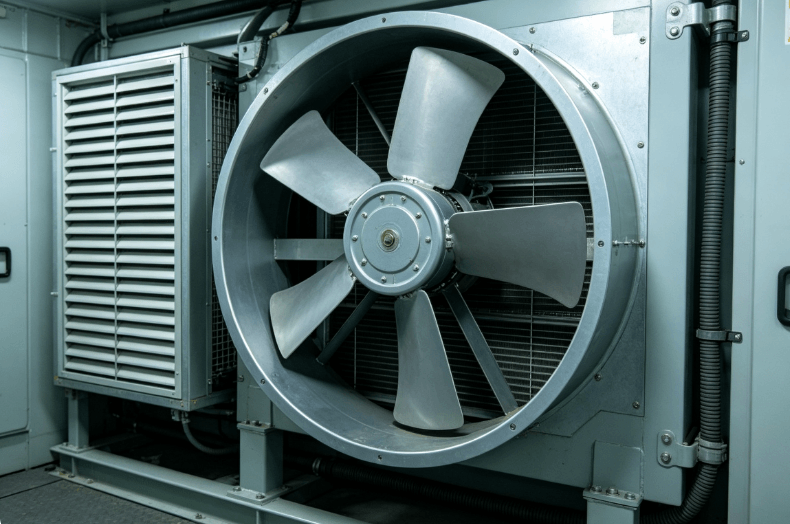
An axial fan for wind turbine cooling is a specialized industrial ventilator. It moves high volumes of air parallel to its rotational axis. This design prioritizes mass airflow over high static pressure.
Axial designs are highly efficient for circulating air in open spaces. They provide the necessary volume to exchange the entire air mass quickly.
The Cooling Airflow Workflow
- Intake: The system draws ambient outdoor air through protective intake louvers.
- Acceleration: Fan blades accelerate this air across internal heat exchangers.
- Exhaust: Warmed air is subsequently pushed out through rear exhaust vents.
Some modern turbines use a completely closed-loop cooling configuration. In these setups, internal fans circulate nacelle air through sealed radiators. External fans then blow ambient air across the radiator fins. This configuration prevents moisture and salt from entering the main nacelle area.
Technical Design Considerations for Harsh Environments
Wind energy systems face severe environmental degradation risks. Cooling components must endure temperature extremes, moisture, and corrosion. Design engineers carefully specify materials based on the specific installation site.
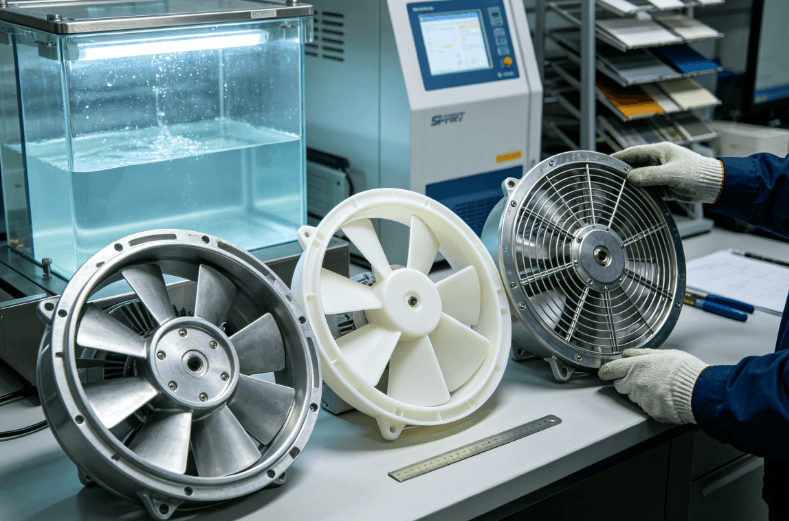
Material selection dictates the lifespan of the entire cooling system. Cast aluminum hubs and blades resist severe salt spray corrosion. Aluminum axial fans remain the standard choice for offshore wind farms.
Onshore wind farms often utilize industrial plastic components. Engineered plastic axial fans offer lightweight performance and excellent UV resistance. They require less motor torque to spin up to operational speeds.
Explosion-proof axial fans are necessary for specific hazardous zones. These specialized units prevent electrical sparks in areas containing combustible dust. They are heavily regulated by international industrial safety directives.
Cooling Material Suitability by Environment
| Material Specification | Ideal Deployment | Environmental Resistance | Relative Weight |
| Cast Aluminum | Offshore / Coastal | Excellent (ISO 9227) | Medium |
| Engineered Plastic | Onshore / Arid | High UV Resistance | Very Light |
| Explosion-Proof | Hazardous Zones | Non-Sparking | Heavy |
Aerodynamic blade geometry directly impacts efficiency and noise emissions. Standard straight blades move air forcefully but can generate acoustic turbulence. Sickle-shaped axial fan blades reduce aerodynamic drag significantly. This specific profile minimizes acoustic signatures to meet strict local noise regulations.
Key Cooling Applications Inside the Nacelle
Different zones within the turbine require distinct thermal strategies. Main generator cooling always demands the highest airflow capacity. Large size aluminum axial fans often blow directly across generator cooling fins.
This continuous airflow keeps the stator and rotor within safe limits. Transformer compartments require dedicated, uninterrupted ventilation systems as well. These confined electrical cabinets often utilize medium size plastic axial fans.
Pitch and yaw motors also require localized thermal management. These critical motors continuously adjust the blade angles and turbine orientation. Small to medium fans prevent these motors from overheating during severe storms.
Air-to-air heat exchangers form the backbone of advanced cooling systems. Internal fans push hot nacelle air through the heat exchanger core. External fans pull freezing or humid outside air across the opposite side.
Evaluating Cooling Systems and OEM Manufacturing
Sourcing reliable cooling components requires evaluating the manufacturer’s true production capabilities. Wind turbine OEMs must match fan specifications to precise thermal loads. This requires precision tooling for axial fan blades, bushings, and hubs.
For offshore applications, extreme salt spray testing is an absolute requirement. Components must pass rigorous ISO 9227 artificial atmosphere evaluations. This prevents catastrophic fan failure during aggressive winter storm seasons.
Sampling delays may occur when engineering highly customized fan hubs. Working with an established manufacturer accelerates the initial prototyping phase. Standardized components often provide faster turnaround times for maintenance cycles.
NANJING COLORFAN TECHNOLOGY CO., LTD focuses on manufacturing high-end axial fan solutions for industrial applications. Their manufacturing capabilities cover aluminum, plastic, and explosion-proof fan designs. They support global industrial projects with diverse configuration options, including large 6W/9W models and medium P4Z/7XL models.
When selecting components, project managers carefully analyze blade pitch and diameter. For project-specific requirements, engineers can directly contact their technical team to verify specifications. A well-matched fan assembly reduces turbine downtime and lowers long-term maintenance costs.
Frequently Asked Questions
What is the primary function of a cooling fan in a wind turbine?
A cooling fan regulates internal temperatures by expelling thermal energy. It forces ambient air across hot surfaces like generators and gearboxes. This continuous airflow prevents electrical insulation degradation and mechanical failure.
How does a sickle-shaped blade differ from standard designs?
Sickle-shaped blades feature a highly curved aerodynamic profile. This geometry reduces air resistance and turbulence during high-speed rotation. Consequently, sickle blades operate much more quietly than straight-blade designs.
Why are aluminum materials preferred for offshore turbines?
Offshore environments expose equipment to extreme moisture and salt spray. Aluminum provides superior natural resistance to this corrosive marine environment. It maintains structural integrity without adding excessive weight to the turbine nacelle.
How do closed-loop cooling systems work in turbines?
Closed-loop systems prevent outside ambient air from entering the nacelle. Internal fans circulate hot air through a sealed internal heat exchanger. External fans then blow ambient air across the outside of the exchanger to remove the heat.
What IP rating is required for turbine cooling fans?
Offshore marine environments typically require strict IP65 sealing standards. This rating ensures the fan motor is completely protected against dust ingress. It also provides protection against low-pressure water jets from any direction.
Reference Sources
- International Electrotechnical Commission (IEC): IEC 61400 – Wind Energy Generation Systems Design Requirements.
- International Organization for Standardization (ISO): ISO 9227 – Corrosion Tests in Artificial Atmospheres.
- IEEE Standards Association: IEEE 1-2000 – General Principles for Temperature Limits in the Rating of Electric Equipment.