

Axial fan vibration is commonly caused by impeller imbalance, worn bearings, loose mounting components, shaft misalignment, or unstable airflow. Identifying the source requires checking mechanical condition, rotational speed, vibration frequency, and operating conditions rather than assuming every vibration problem comes from unbalanced blades.
Some vibration is unavoidable in rotating machinery. However, excessive vibration can accelerate bearing wear, loosen fasteners, damage blade assemblies, and shorten equipment service life.
For industrial fans operating in cooling, ventilation, and heavy equipment applications, diagnosing vibration early is essential. The most effective approach is to establish whether the problem originates from the rotating assembly, supporting structure, or airflow system.
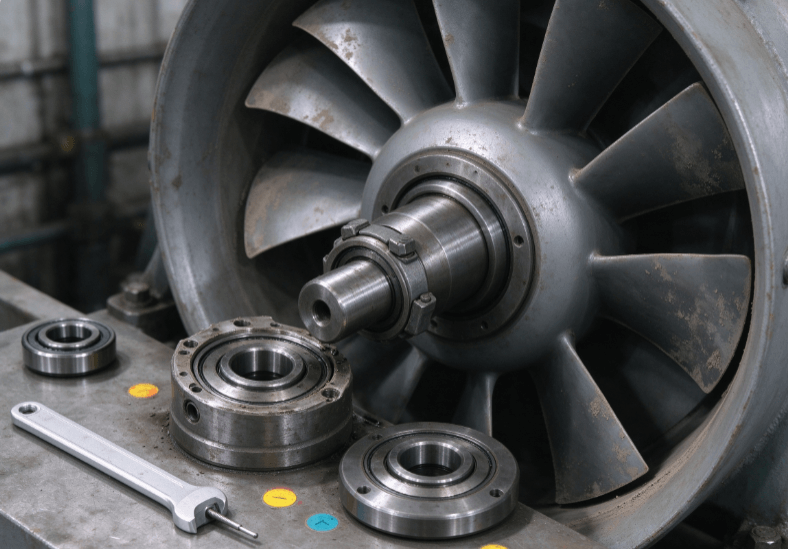
What Causes Excessive Axial Fan Vibration?
An axial fan transfers mechanical forces through its shaft, bearings, housing, and mounting structure. Vibration develops when these forces become excessive or interact with the natural frequencies of connected components.
Different faults produce different vibration patterns.
| Common Cause | Typical Symptoms | Initial Inspection |
|---|---|---|
| Impeller imbalance | Strong vibration near running speed | Blade deposits, damage, and balance |
| Bearing wear | Rough noise, heat, high-frequency vibration | Bearing condition and lubrication |
| Loose mounting | Rattling or changing vibration levels | Bolts, brackets, and support structure |
| Shaft misalignment | Elevated axial or radial vibration | Shaft and coupling alignment |
| Aerodynamic instability | Pulsation and irregular vibration | Airflow restrictions and operating point |
| Structural resonance | Sharp vibration increase at certain speeds | Speed-dependent vibration response |
| Blade damage | Increased noise and uneven operation | Cracks, deformation, and blade clearance |
These symptoms provide diagnostic clues rather than definitive fault identification. Several problems may produce similar vibration signatures.
1. Impeller Imbalance and Uneven Mass Distribution
Impeller imbalance is one of the most common sources of vibration in rotating fans.
It occurs when the rotating assembly’s mass distribution creates an unbalanced centrifugal force.
Possible causes include:
- Dust or material buildup on individual blades
- Erosion that removes material unevenly
- Bent or damaged blades
- Missing balance weights
- Incorrect blade replacement
- Uneven assembly or hub positioning
The resulting vibration often appears predominantly at the rotational frequency, commonly called 1× running speed.
For example, a fan operating at 1,500 RPM has a rotational frequency of:
1,500 ÷ 60 = 25 Hz
A strong vibration component near 25 Hz may indicate imbalance, although other rotating faults can produce similar patterns.
Cleaning the impeller is usually the first inspection step. If vibration remains, the complete rotating assembly may require professional balancing.
2. Bearing Wear and Lubrication Problems
Bearings support the rotating shaft and maintain its position during operation.
When bearing surfaces deteriorate, vibration may increase alongside mechanical noise and operating temperature.
Common contributors include:
- Insufficient or excessive lubrication
- Contaminated grease
- Improper bearing installation
- Excessive axial or radial loading
- Misalignment between bearing supports
- Fatigue damage from prolonged service
Bearing defects often generate vibration components at characteristic frequencies linked to bearing geometry and shaft speed.
High-frequency vibration or changes in envelope-analysis results can help identify early bearing defects.
However, bearing temperature alone is not sufficient to diagnose failure. Temperature must be interpreted against the equipment’s normal operating conditions.
3. Loose Fasteners and Mounting Structures
Loose mounting bolts or deteriorated supports can amplify vibration throughout the fan assembly.
In some installations, the impeller and motor may remain mechanically sound while the supporting structure vibrates excessively.
Potential problems include cracked brackets, uneven mounting surfaces, insufficient structural stiffness, and loose connections.
Before adjusting or replacing rotating components, technicians should inspect the fan housing, motor base, mounting bolts, and supporting frame.
A fan that vibrates significantly after installation may have a mounting problem rather than a manufacturing defect.
4. Shaft Misalignment and Hub Problems
Shaft misalignment is particularly relevant to fans driven through couplings or other mechanical transmission systems.
Angular or parallel misalignment introduces additional forces into bearings and connected components.
Direct-mounted impellers may instead experience problems caused by hub eccentricity, incorrect seating, or damaged shaft connections.
These faults should not be confused with rotor imbalance.
For installations using separate connecting components, inspect the axial fan hub and shaft connection for correct seating and mechanical integrity.
Replacing an impeller without correcting the connection problem may leave the original vibration unresolved.
5. Aerodynamic Instability and Blade Damage
Not all vibration originates from mechanical defects.
Airflow separation, rotating stall, and unstable operation can create fluctuating aerodynamic forces.
These problems may occur when an axial fan operates outside its intended performance range.
Potential contributors include restricted intake airflow, unsuitable blade pitch, distorted inlet conditions, and excessive system resistance.
Blade geometry also affects how aerodynamic loads develop during operation.
The article Axial Fan Blade Design: Structure, Materials & Performance Factors explains how blade profiles and structural characteristics influence fan performance.
Aerodynamic vibration may vary with airflow demand and system configuration. It should not automatically be treated as a balancing problem.
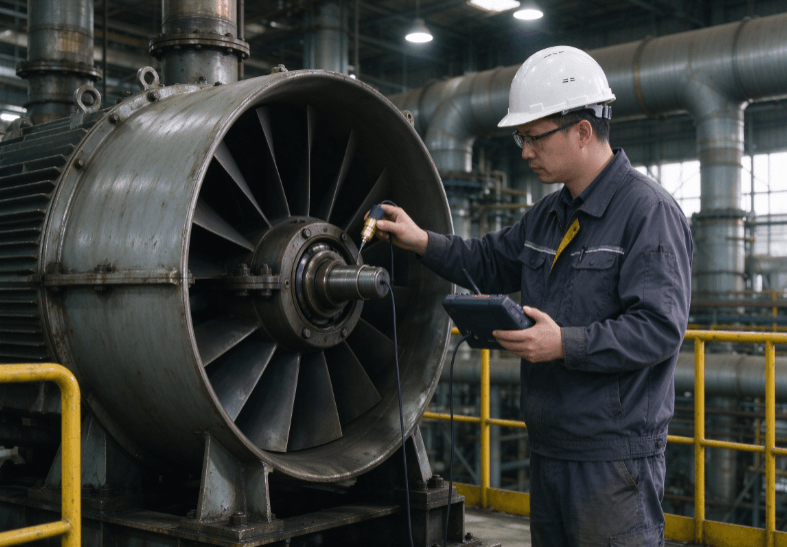
How to Troubleshoot Axial Fan Vibration Step by Step
Effective troubleshooting begins with repeatable observations.
Changing multiple components simultaneously can make the original fault difficult to identify.
Step 1: Record the Operating Conditions
Before starting maintenance, record the fan’s operating speed, load, temperature, airflow conditions, and vibration trend.
Also establish when the vibration started.
A problem appearing immediately after installation suggests different causes from vibration developing gradually over several months.
Useful observations include:
- Actual operating RPM
- Motor current
- Bearing temperature
- Recent maintenance activities
- Changes in operating noise
- Vibration measurements and locations
These details help distinguish installation problems from progressive mechanical deterioration.
Step 2: Inspect the Fan After Safe Shutdown
Isolate the equipment using appropriate lockout/tagout procedures and verify that rotation has stopped.
Inspect the impeller for deposits, cracks, deformation, and missing components.
Check accessible mounting hardware, bearings, shaft connections, and blade-tip clearance.
Never attempt to touch, clean, or adjust rotating blades during operation.
If cracked blades, loose hub connections, or severe mechanical damage are found, the fan should remain out of service until repaired and assessed.
Step 3: Measure Vibration at Consistent Locations
A vibration analyzer can measure acceleration, velocity, and displacement.
For general rotating machinery assessments, vibration velocity is commonly used to evaluate overall mechanical vibration severity.
Measurements should be taken at repeatable locations near bearing housings or other designated points.
Record the measurement direction and operating speed.
A change in measurement position can affect comparisons, particularly when the supporting structure has flexible or resonant behavior.
Step 4: Examine the Vibration Frequency
Frequency analysis can reveal patterns associated with particular mechanical or aerodynamic faults.
| Vibration Pattern | Possible Cause | Additional Check |
|---|---|---|
| Dominant 1× running speed | Imbalance or eccentricity | Impeller condition and phase |
| Strong 2× component | Possible misalignment or looseness | Couplings and shaft alignment |
| Multiple harmonics | Mechanical looseness or contact | Mounting and clearances |
| High-frequency broadband energy | Bearing damage or friction | Bearing inspection |
| Speed-specific vibration peak | Structural resonance | Controlled speed-response testing |
| Irregular low-frequency fluctuations | Aerodynamic instability | Operating point and airflow |
Frequency signatures are diagnostic indicators, not proof of a specific defect.
Reliable diagnosis may require phase measurements, bearing-envelope analysis, operating-deflection measurements, or additional inspection.
Step 5: Correct the Cause and Verify the Result
Repairs should address the identified defect rather than merely reducing the measured vibration.
Depending on the diagnosis, corrective actions may include:
- Cleaning accumulated deposits from the impeller.
- Replacing damaged blades or worn bearings.
- Correcting shaft alignment or hub seating.
- Restoring mounting stiffness and secure connections.
- Performing dynamic balancing.
- Correcting restrictive airflow conditions.
After maintenance, repeat the measurements under comparable operating conditions.
The fan should also be monitored for abnormal noise, temperature rise, and recurring vibration.
Understanding Fan Vibration Limits and Balancing Standards
There is no single acceptable vibration value for every industrial axial fan.
Permissible levels depend on fan category, operating speed, mounting arrangement, measurement method, and applicable specifications.
Two references commonly used in fan engineering are:
ISO 14694:2003 — Industrial fans: Specifications for balance quality and vibration levels.
ANSI/AMCA 204-20 — Balance Quality and Vibration Levels for Fans.
These standards address fan balancing and vibration evaluation within their respective scopes.
A critical distinction is that rotor balance quality and installed vibration are not the same measurement.
A correctly balanced impeller can still exhibit excessive vibration after installation because of structural resonance, improper mounting, or unstable aerodynamic conditions.
Likewise, a low overall vibration reading does not guarantee that bearings or blades are free from defects.
Engineers should use the applicable fan vibration category, test conditions, and manufacturer documentation when evaluating acceptance limits.
Arbitrary thresholds should not replace equipment-specific requirements.
Axial Fan Vibration in Industrial Cooling and Ventilation
Vibration behavior depends partly on where the fan operates.
Diesel Generator and Radiator Cooling
Cooling fans installed near diesel engines may experience vibration transmitted from the engine or surrounding equipment.
This makes it important to distinguish fan-generated vibration from external excitation.
Radiator restrictions and changes in engine speed can also affect aerodynamic loading.
Measurements taken at different speeds may reveal whether vibration follows the fan’s rotational frequency or another mechanical source.
Construction Machinery and Outdoor Equipment
Fans installed in construction machinery often operate under demanding environmental conditions.
Dust accumulation and uneven blade erosion can gradually change impeller balance.
Frequent changes in operating speed may also expose structural resonances that are less noticeable during steady operation.
Periodic blade inspection is particularly important in these environments.
Industrial Ventilation Systems
Large ventilation fans may experience vibration caused by duct connections, support flexibility, or disturbed inlet airflow.
An otherwise acceptable impeller can produce elevated vibration when installed in a mechanically flexible structure.
Where replacement parts are required, the axial fan blade range illustrates different industrial blade configurations.
Replacement suitability depends on geometry, material, mounting compatibility, speed rating, and balancing requirements.
When Should a Fan Impeller Be Replaced?
Not every vibration problem requires a new impeller.
Cleaning, bearing replacement, alignment correction, or balancing may restore acceptable operation when the rotating assembly remains structurally sound.
Replacement becomes more appropriate when inspections identify:
- Blade cracking or permanent deformation
- Severe erosion affecting structural integrity
- Damaged blade-root connections
- Unrepairable hub or impeller defects
- Mechanical damage that prevents reliable balancing
The replacement assembly must satisfy the original equipment’s operating requirements.
Matching external diameter alone is insufficient. Blade geometry, rotation direction, mechanical limits, and connection dimensions must also be verified.
FAQ
Why does my axial fan vibrate at high RPM?
Vibration may increase at high RPM because centrifugal forces become larger as rotational speed increases.
High-speed operation can also expose structural resonance, bearing defects, or aerodynamic instability. A vibration peak occurring within a narrow speed range may indicate resonance rather than simple imbalance.
Can an unbalanced axial fan damage the motor?
Yes. Excessive impeller imbalance can transmit additional dynamic loads through the shaft and bearings.
Prolonged operation may accelerate bearing wear, loosen mounting connections, and affect motor reliability. The severity depends on vibration amplitude, operating speed, and mechanical design.
How do you balance an axial fan impeller?
Fan balancing involves measuring rotor unbalance and correcting its mass distribution.
Depending on the assembly, technicians may add or remove correction mass at approved locations. Professional balancing equipment should be used, especially for large or high-speed impellers.
Balancing should follow the applicable balance quality specification.
What causes axial fan vibration after blade replacement?
Common causes include incorrect blade positioning, unequal blade mass, improper hub seating, or incompatible replacement components.
Incorrect pitch settings may also produce uneven aerodynamic loading.
After replacing blades, technicians should verify assembly geometry, mounting security, clearances, and the balance of the complete rotating assembly.
Can poor airflow cause axial fan vibration?
Yes. Restricted airflow, inlet disturbances, and operation near unstable regions of a fan’s performance curve can generate fluctuating aerodynamic forces.
These forces may produce vibration even when the impeller is mechanically balanced.
Inspect the airflow path and verify the operating point before assuming the problem requires mechanical balancing.
Summary
Axial fan vibration can originate from mechanical imbalance, bearing deterioration, loose supports, incorrect shaft connections, or unstable airflow.
The most reliable troubleshooting method combines physical inspection with measurements taken under documented operating conditions.
Frequency analysis can help narrow down the likely cause, but findings should be confirmed before repairs are performed.
For industrial installations, successful maintenance means more than reducing vibration temporarily. It means correcting the underlying fault, verifying safe operation, and establishing a reliable baseline for future monitoring.