

Choosing between aluminum and plastic axial-fan components affects weight, corrosion resistance, manufacturability and long-term behaviour in service. This article compares materials and common application trade-offs, separates what COLORFAN’s product pages document from independent engineering guidance, and lists RFQ items you should confirm before purchasing.
Overview: aluminum vs plastic — basic differences
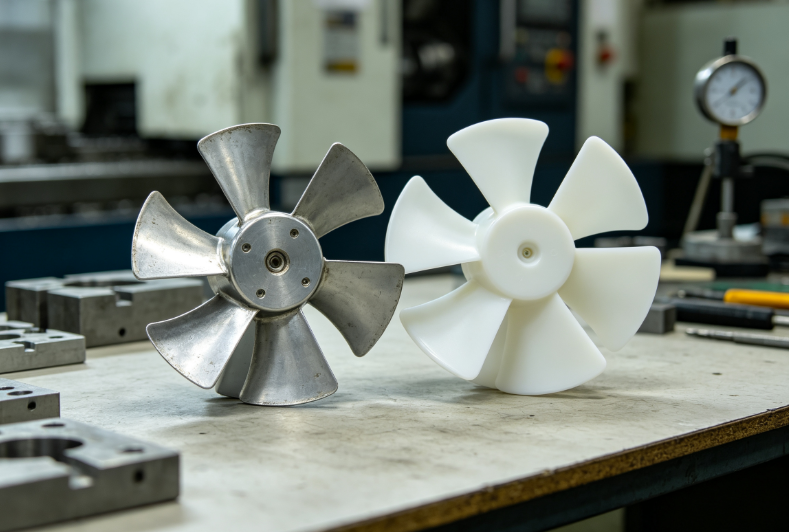
Aluminum alloys and engineering plastics used for axial-fan blades and hubs have different mechanical, thermal and corrosion properties. In general terms: aluminum offers higher stiffness and thermal conductivity; plastics typically give lower mass, intrinsic corrosion resistance, and the possibility of complex molded geometries. These material tendencies influence manufacturing method, part tolerances and application envelopes, but do not by themselves determine fan performance — blade geometry, hub design and system installation do.
Materials and manufacturing considerations
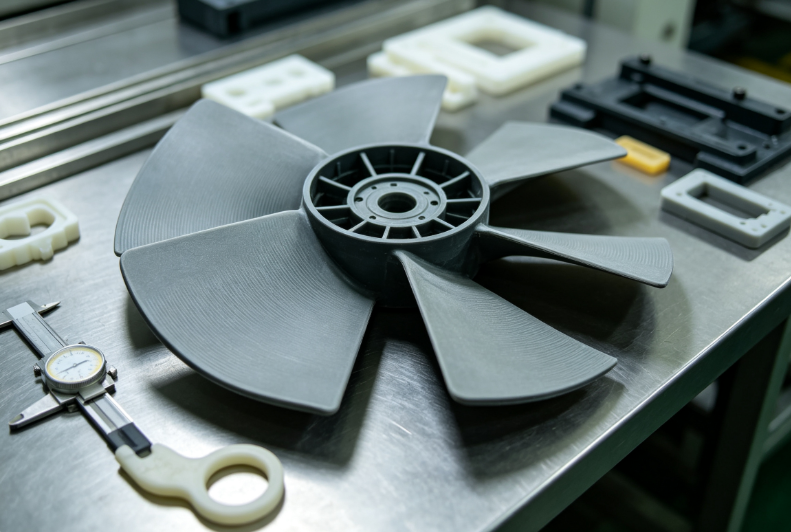
Aluminum fan parts are commonly machined, cast or die-cast; alloy choice and post-processing (machining, shot-peening, anodizing or painting) change fatigue life and corrosion resistance. Plastic blades (for example, nylon-filled, glass-reinforced nylons or other thermoplastics) are usually injection-molded and can integrate features like clip-in mounting or aerodynamic profiles without secondary machining. Design trade-offs include:
- Stiffness vs mass: aluminum achieves higher elastic modulus for a given section, while plastics reduce rotating inertia and can lower bearing loads.
- Temperature limits: plastics have glass transition and softening ranges that limit high-temperature use; aluminum retains stiffness at elevated temperatures but surface protection may be needed in corrosive environments.
- Manufacturing costs: tooling for plastic injection molding introduces higher upfront cost but lower per-piece cost at scale; aluminum castings or machined parts have different cost curves.
When selecting materials for a specific axial-fan application, confirm the polymer type, filler content, alloy grade and any surface treatment with your supplier; these directly affect mechanical and environmental performance.
Performance factors (what changes, what doesn’t)
Material choice influences several performance-related factors without directly setting airflow or static-pressure values (those depend on fan geometry and system resistance):
- Rotating mass and dynamic balance: lower-mass plastic assemblies can reduce dynamic loads on bearings at the same RPM, while heavier aluminum parts can increase stored kinetic energy and bearing stress during acceleration or shock events.
- Vibration and resonance: aluminum’s higher stiffness moves natural frequencies; plastic components may damp vibrations better but can also exhibit viscoelastic behaviour that changes with temperature and age.
- Surface finish and blade accuracy: tighter dimensional control (and therefore repeatable aerodynamic performance) depends on manufacturing and finishing processes rather than material alone.
Comparison table — aluminum axial fan vs plastic axial fan (qualitative)
| Attribute | Aluminum | Plastic |
|---|---|---|
| Typical stiffness | Higher (better dimensional stability) | Lower (may require larger sections) |
| Mass / inertia | Higher | Lower |
| Corrosion resistance | Depends on coating; needs protection in corrosive environments | Generally intrinsic corrosion resistance (polymer dependent) |
| Temperature tolerance | Higher | Limited by polymer glass transition or heat distortion |
| Manufacturing | Machined/cast/die-cast; good for small-medium runs or complex metal features | Injection-molded; cost-effective at high volumes and complex geometries |
| Repairability / recyclability | Often recyclable; surface repair possible | Recyclability depends on polymer and fillers; repair limited |
| Typical applications | Higher-temperature or stiffness-critical uses | Corrosion-prone, weight-sensitive or high-volume OEM applications |
Supplier-page facts (what COLORFAN documents)
- COLORFAN lists axial fans and fan parts including axial fan hubs and axial fan blades on its products pages.
- The supplier’s catalogue includes product entries named for alloy hubs and multiple blade types, for example: Alloy hub for axial fan (10H, 8W, 8H, 6Z, 6W, 6H, 3W) and blade listings such as Medium Size Alloy Axial Fan Blade R4Z and Medium Size Plastic Nylon Axial Fan Blade P5Z, among others. These entries indicate product families for both aluminum and plastic components but do not by themselves specify application limits or performance curves.
- COLORFAN’s site also contains technical guidance pages about blade design, axial-flow fan principles and selection guides; these are useful starting points when evaluating material choices.
For the supplier’s listings and technical pages, see the COLORFAN product guide and selection pages: Products overview and Plastic vs Aluminum technical selection guide.
Independent engineering guidance (evidence-first)
- Fan-system performance should be evaluated using fan laws and Best Efficiency Point (BEP) guidance; operating close to a fan’s BEP generally improves energy efficiency and reduces wear. Practical fan-selection and system-design rules are covered in DOE fan-system guidance [1].
- When fans are part of ventilation systems that control hazardous substances, exhaust and local-ventilation installations must be designed and operated according to workplace ventilation regulations to avoid exposing workers to contaminants; for example, OSHA sets requirements for local exhaust design, discharge and maintenance that should be followed where applicable [2].
RFQ checklist — supplier confirmations you should request
Below are specific items to confirm with COLORFAN (or any supplier) before placing an order. Items marked “RFQ confirmation required” indicate they are product- or project-specific and are not documented solely by the public product pages.
- Exact part number and drawing for the blade or hub assembly — RFQ confirmation required.
- Material specification: alloy grade for aluminum parts or polymer grade and filler content for plastics — RFQ confirmation required.
- Surface treatment or coating details (anodize, paint, passivation) — RFQ confirmation required.
- Dimensional drawings with tolerances and mounting features (bore size, keyways, bolt pattern) — RFQ confirmation required.
- Static and dynamic balancing grade achieved and test reports (G-class or custom balance) — RFQ confirmation required.
- Maximum recommended operating temperature and any long-term ageing data — RFQ confirmation required.
- Recommended RPM limits and validated speed-testing evidence — RFQ confirmation required.
- Compatibility confirmation with the intended hub, shaft or motor model — RFQ confirmation required.
- Quality control and inspection checkpoints (e.g., dimensional inspection, balance certification) — RFQ confirmation required.
- Packaging, shipping method and handling constraints for long blades or assemblies — RFQ confirmation required.
- Minimum order quantity, lead time and available batch sizes — RFQ confirmation required.
- Any available sample policy, prototype machining, or trim-run options — RFQ confirmation required.
FAQ
Q1: Which material is better for high-temperature exhaust fans?
Answer: Aluminum alloys typically retain stiffness and dimensional stability at higher temperatures than common thermoplastics; however, the correct choice depends on the specific operating temperature, chemical exposure and mechanical loads. Confirm maximum service temperature and any protective coatings with the supplier — RFQ confirmation required.
Q2: Can plastic blades be used outdoors or in corrosive atmospheres?
Answer: Many plastics are corrosion-resistant and suitable for moist or chemically aggressive atmospheres, but UV exposure, specific chemical compatibility and long-term creep must be evaluated for the chosen polymer and additives. Ask the supplier for polymer data sheets and field-aging information — RFQ confirmation required.
Q3: How does material affect fan balancing and vibration?
Answer: Material density and manufacturing tolerances influence dynamic balance. Aluminum parts often require precise machining or finishing for balance, while molded plastic parts can be inherently balanced if molds and tooling are accurate. Request balance-class certification and test reports from the supplier.
Q4: Are there clear energy differences between aluminum and plastic fans?
Answer: Material alone does not determine fan energy consumption — blade profile, diameter, pitch, RPM and system resistance dominate. Material affects rotating inertia and structural deflection, which can influence operating efficiency indirectly. Use system-level fan curves and DOE fan-law guidance when estimating energy use [1].
Q5: What documentation should accompany a purchase?
Answer: At minimum, request drawings, material certificates, balance/test reports and packaging instructions. Any application-specific requirements (e.g., fire resistance, UV stabilisation, or ATEX/hazardous-area approvals) must be requested explicitly — RFQ confirmation required.
Conclusion & next steps (non-coercive)
Aluminum and plastic axial-fan components each have defensible advantages. Use the comparison above to narrow candidate materials, then request the RFQ confirmations listed. For product browsing and technical information from COLORFAN, see the Products overview and the supplier’s blade design and materials guidance. If you plan to proceed, prepare drawings and operating conditions and send them to your supplier to obtain validated part data and quotes.
References
- [1] U.S. Department of Energy — Fan System Cheat Sheet.
- [2] U.S. OSHA — 1926.57 Ventilation.
- COLORFAN product and technical pages: https://colorfan-dele.com/products/ and https://colorfan-dele.com/plastic-axial-fan-vs-aluminum-axial-fan-technical-selection-guide/