

For equipment manufacturers, EPC contractors, and OEM project managers, selecting a qualified industrial axial fan supplier involves much more than comparing unit costs. In high-demand environments like diesel generator enclosures, cooling towers, and factory ventilation systems, the fan is a critical point of failure. A reliable supplier must bridge the gap between theoretical aerodynamic design and consistent, scalable manufacturing.
When sourcing components for global projects, your chosen partner must demonstrate strict control over the entire assembly—from the blade pitch and hub geometry to the precision of the shaft bushing. This guide provides a technical framework for evaluating an axial fan factory, comparing material properties, and structuring your Request for Quote (RFQ) to ensure seamless project integration.
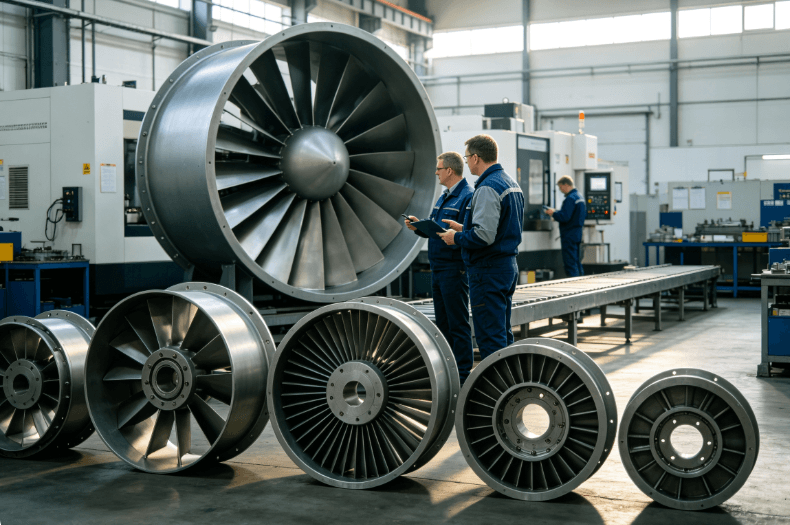
Evaluating an Industrial Axial Fan Supplier for OEM Projects
A mature industrial ventilation fan supplier understands that a fan is not a one-size-fits-all commodity. It is a highly engineered component that must operate flawlessly at a specific operating point on a system curve.
When evaluating potential suppliers, engineering and procurement teams should look for comprehensive in-house capabilities rather than simple assembly operations. Key indicators of a capable manufacturer include:
- Customization Range: The ability to provide a wide span of sizes. A strong supplier should cover everything from compact cooling units to large diameter axial fans (e.g., 145 mm to 2200 mm) to support diverse industrial demands.
- Aerodynamic Data Provision: The supplier should be able to provide clear performance curves detailing airflow, static pressure, and the best efficiency point (BEP) for their impellers.
- Component Modularity: The capacity to supply complete fan assemblies or individual components such as axial fan blades, hubs, and bushings based on the OEM’s specific integration needs.
Before diving into procurement specifics, engineers who need to review the foundational aerodynamics, motor interactions, and system resistance calculations can consult this comprehensive guide on axial fan technical principles.
Engineering Capabilities: From Components to Wind Tunnel Testing
The operational stability of an industrial fan relies heavily on the mechanical integrity of its core components and the rigor of its testing protocols.
Blade, Hub, and Bushing Integration
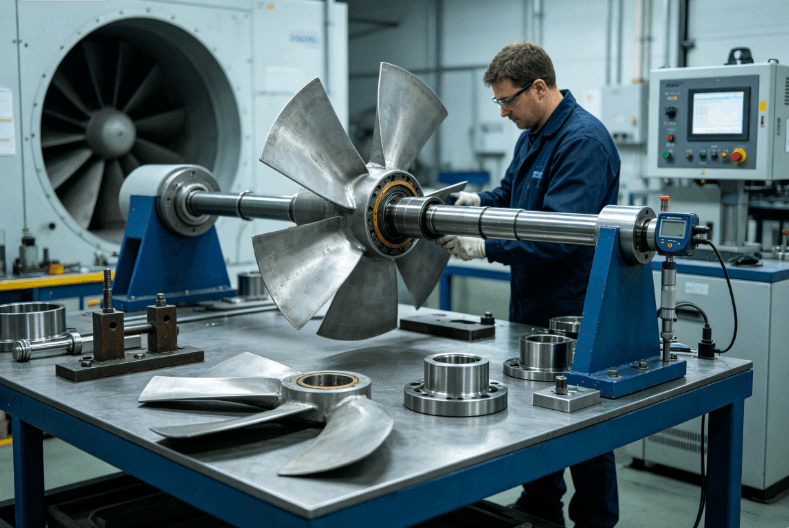
The transition point between the fan blade and the hub is subjected to immense centrifugal and aerodynamic stress. A reliable supplier utilizes precision-engineered hubs and bushings to ensure absolute shaft compatibility. Poor concentricity or loose shaft fit tolerances can lead to severe runout, resulting in high vibration levels that can prematurely destroy motor bearings. Whether you are ordering a full fan or replacement parts, confirm that the hub-to-blade transition and bushing tolerances match your drive system specifications.
Wind Tunnel Testing and Balancing
You cannot verify aerodynamic performance through CAD models alone. Look for a supplier that utilizes physical wind tunnel testing to validate the airflow and static pressure characteristics of their designs. Additionally, dynamic balancing is critical. All industrial impellers should be balanced to recognized engineering standards (such as ISO 1940-1) to mitigate vibration, especially in large diameter axial fans operating at high RPMs.
Material Selection: Plastic vs. Aluminum Axial Fans
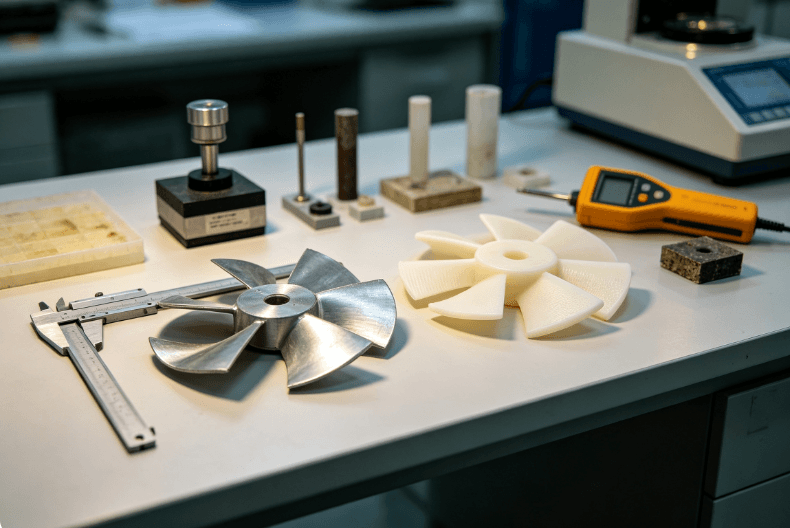
Selecting the correct blade material is a primary engineering decision that directly impacts the fan’s thermal limits, weight, and corrosion resistance. An experienced supplier will guide you through this selection based on your specific application environment.
Below is a general engineering comparison of the two most common industrial fan materials:
| Decision Factor | Aluminum Axial Fans | Plastic Axial Fans |
| Typical Strength & Rigidity | Excellent structural integrity; resists deformation under high static pressure. | Lightweight; reduces load on motor bearings and lowers startup torque. |
| Temperature Suitability | Ideal for high-temperature environments (e.g., engine radiators, heavy machinery). | Best for ambient or moderately warm environments. (Thermal limits depend on specific polymer blends). |
| Corrosion Resistance | Good, but may require special coatings in highly acidic or saline environments. | Highly resistant to moisture, chemical fumes, and atmospheric corrosion. |
| Manufacturing Flexibility | Excellent for heavy-duty custom profiles and explosion-proof requirements. | Excellent for mass OEM production via injection molding; highly consistent blade profiles. |
| Vibration Damping | Lower natural damping; requires precise dynamic balancing. | Inherently better at absorbing minor mechanical vibrations. |
Note: For explosion-proof applications, the material and coating must be verified against the final application and certification requirements (such as ATEX or UL).
Typical Applications for Large Diameter Axial Fans
Industrial axial fans are deployed across a variety of demanding sectors. When discussing your project with a supplier, inquire about their experience in your specific industry, as environmental constraints vary wildly:
- Wind Power Projects: Fans used in turbine nacelles must operate reliably in remote, harsh conditions where maintenance is exceptionally difficult.
- Diesel Generators and Engineering Vehicle Radiators: These fans face high ambient temperatures, heavy vibration, and continuous thermal cycling, requiring robust aluminum blades and high-strength hubs.
- Cooling Towers: Operating in 100% humidity environments, these fans demand strict corrosion resistance and large diameters to move massive volumes of air at low speeds.
- Hovercraft and Heavy Transportation: Requires high-velocity airflow and lightweight components to maximize thrust and efficiency.
- Industrial Ventilation: General factory exhaust and supply systems require fans optimized for steady, continuous airflow with low energy consumption.
To view component options suitable for these applications, explore the full range of industrial axial fan products.
RFQ Preparation: How to Specify Your Industrial Fan
A generic inquiry often leads to mismatched products and delayed timelines. To accelerate the OEM engineering process and receive an accurate quote, your Request for Quote (RFQ) must include specific aerodynamic and mechanical parameters.
When contacting your axial fan factory, prepare the following confirmation items:
- Required Airflow: Stated in CFM (Cubic Feet per Minute) or m³/h.
- Static Pressure / Air Pressure: Stated in Pa (Pascals) or inWG (Inches of Water Gauge) based on your system resistance curve.
- Operating Temperature: Minimum and maximum ambient air temperatures the fan will encounter.
- Blade Diameter: Specify the physical size constraints (e.g., within the 145 mm to 2200 mm range).
- Drive Mode: Specify if it is a direct drive, belt drive, or other configuration.
- Connection Mode and Installation Mode: Outline how the hub mounts to the shaft and the physical orientation of the fan (horizontal, vertical, or angled).
- Delivery Scope: Clarify whether you need the complete fan assembly (motor, housing, impeller) or just the individual components (axial fan blades, hubs, and bushings).
Always request the dimension drawing, aerodynamic performance curve, and test documentation from the supplier before final engineering approval.
Partnering with the COLORFAN Factory
For procurement teams and engineers seeking a dedicated manufacturing partner, NANJING COLORFAN TECHNOLOGY CO., LTD operates as a specialized manufacturer and designer of high-end axial fans, draught fans, and cooling fans.
COLORFAN provides end-to-end support for global OEM and ODM projects. The factory’s in-house capabilities encompass comprehensive R&D, mould processing, and precision injection molding. By maintaining strict oversight of production—from raw material forming to final wind tunnel testing—COLORFAN ensures that every fan, whether it is a standard plastic cooling fan or a heavy-duty aluminum assembly, meets exacting industrial standards.
Because every industrial cooling system is unique, lead times, MOQ (Minimum Order Quantity), and specific compliance data depend on the operating point and project conditions. Contact the COLORFAN engineering team today with your RFQ parameters to discuss your custom airflow solution.
FAQ
Q: What information is required to select the correct industrial axial fan?
A: To ensure accurate selection, you must provide the supplier with the required airflow, static pressure, operating temperature, drive mode, connection mode, installation mode, and the required blade diameter.
Q: Can I source only the axial fan blades and hubs instead of a complete unit?
A: Yes. Many OEM clients and equipment manufacturers choose to source specific components, such as blades, hubs, and shaft bushings, to integrate into their own proprietary motor and housing assemblies.
Q: How do I know if an explosion-proof axial fan meets my facility’s safety standards?
A: Explosion-proof ratings are strictly regulated by regional standards (e.g., ATEX in Europe, UL/NEC in North America). You must provide the supplier with your specific hazardous zone classification so they can confirm if the fan materials and motor construction comply with your final certification requirements.
Q: Does the manufacturer provide aerodynamic performance curves?
A: A reputable industrial axial fan supplier will provide performance curves generated through wind tunnel testing. You should request these documents during the RFQ phase to verify the fan’s best efficiency point against your system’s resistance curve.
Q: What is the available diameter range for COLORFAN industrial axial fans?
A: COLORFAN manufactures and designs axial fans with diameters ranging from 145 mm up to 2200 mm, accommodating everything from compact vehicle radiators to large-scale cooling towers.
Reference Sources
- AMCA (Air Movement and Control Association): General principles of fan aerodynamic performance testing and Certified Ratings Programs. (Supports the necessity of physical wind tunnel testing and static pressure calculations mentioned in the text).
- ISO 1940-1 / ISO 14694: Industrial fans — Specifications for balance quality and vibration levels. (Supports the engineering guidance provided on dynamic balancing, runout, and vibration control for large diameter impellers).